
Understanding Block Machines: Do You Really Need One?
Investing in industrial equipment requires clear justification. Before committing capital to a concrete block machine, evaluate whether producing your own units creates a measurable operational advantage over sourcing from commercial yards.
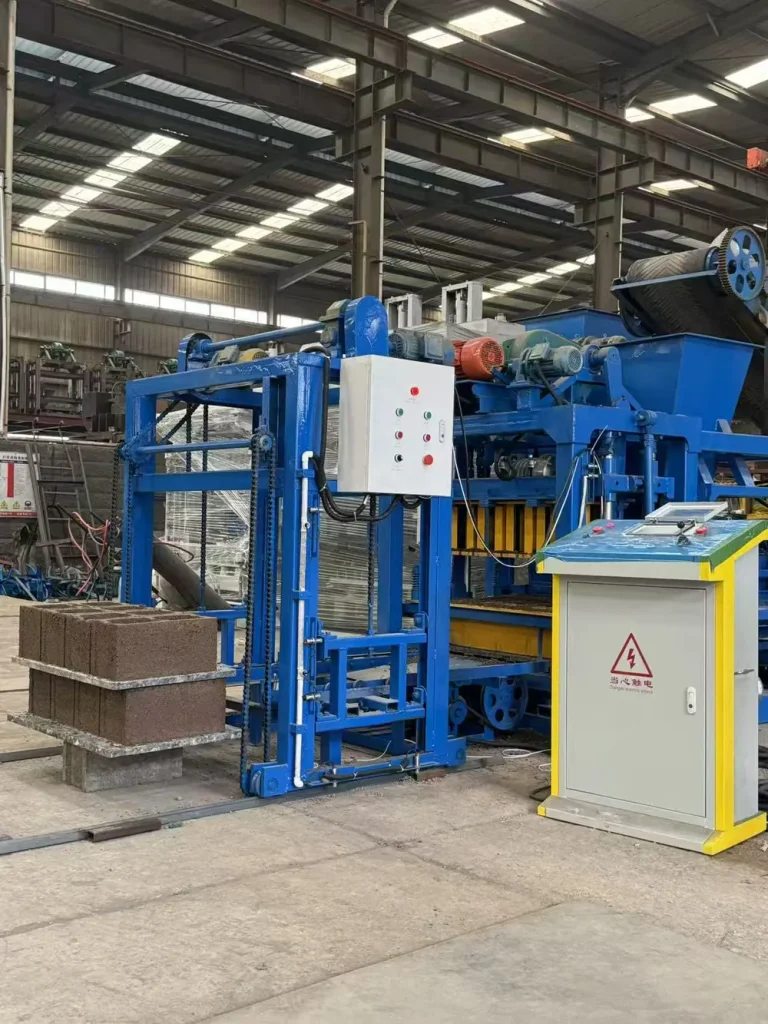
How Concrete Block Making Machines Work
Modern concrete block machinery transforms bulk raw materials into high-strength, uniform masonry products through a rapid, automated cycle:
- Batching and Mixing: Aggregate (sand, gravel, crushed stone, slag), cement, and water are measured and mixed into a low-slump, semi-dry concrete mix.
- Feeding: The mixed material drops into a feed hopper, which evenly distributes it into precision-machined mold cavities.
- Compaction via Vibration and Pressure: High-frequency vibration tables work synchronously with top-down hydraulic pressure heads to eliminate voids and achieve target density.
- Demolding: The mold box lifts while the tamper head holds the formed units in place, stripping green blocks onto production pallets or directly onto a concrete slab.
- Curing: Fresh blocks move to curing racks, chambers, or open yards to hydrate and reach full structural compressive strength.
| Process Stage | Key Equipment | Critical Parameter |
|---|---|---|
| Material Prep | Pan or Planetary Mixer | Water-cement ratio (semi-dry consistency) |
| Forming | Main Mold & Core Assembly | Dimensional accuracy and surface finish |
| Compaction | Hydraulic Cylinders + Vibrators | Compressive force (PSI) and vibration frequency (Hz) |
| Handling | Pallet Conveyor / Stacker | Minimal cycle shock to prevent block deformation |
Buying vs. Outsourcing: When Does Machine Ownership Make Sense?
Sourcing pre-made concrete blocks works well for short-term or low-volume contractors. However, scaling operations quickly reveal the limits of third-party suppliers.
- Buy an in-house block machine if:
- Your steady monthly consumption exceeds 10,000 standard blocks.
- Local suppliers suffer from frequent stockouts, project delays, or inconsistent compressive strength.
- Transport costs from the nearest commercial block plant exceed 15% to 20% of your total unit price.
- You need custom specifications, such as interlocking pavers, lightweight blocks, or decorative retaining wall units.
- Continue outsourcing if:
- Your projects are sporadic with months of downtime between construction phases.
- Available working capital cannot absorb initial installation, mold sets, and raw material inventory.
- You lack the footprint for aggregate stockpiles, production lines, and curing yards.
Assessing Local Market Demand and Production Viability
A machine is only as profitable as the market it serves. Calculate local viability using four distinct metrics:
- Sustained Building Starts: Track municipal permits, commercial infrastructure plans, and residential developments within a 50-kilometer radius. Transporting heavy masonry products beyond this radius drastically reduces profit margins.
- Competitor Price Mapping: Benchmark the wholesale price of standard hollow blocks, solid bricks, and pavers in your immediate operational zone. Calculate your raw material cost per unit (cement, sand, electricity, labor) to confirm a minimum 30% gross operating margin.
- Supply Chain Reliability: Confirm that cement distributors and aggregate quarries can support your daily production capacity without supply disruptions.
- Regulatory Compliance: Verify that local builders accept blocks manufactured to regional standards (such as ASTM C90 or EN 771-3). Your machine must reliably deliver the required structural ratings.
Types of Block Making Machines Explained
Choosing the right equipment starts with understanding how different designs handle workload, cycle times, and structural density. We build and operate equipment across varying scales, and matching the mechanical footprint to operational targets prevents capital waste. For an in-depth breakdown of machine categories, see our guide on 6 types of cement block machines explained for buyers.
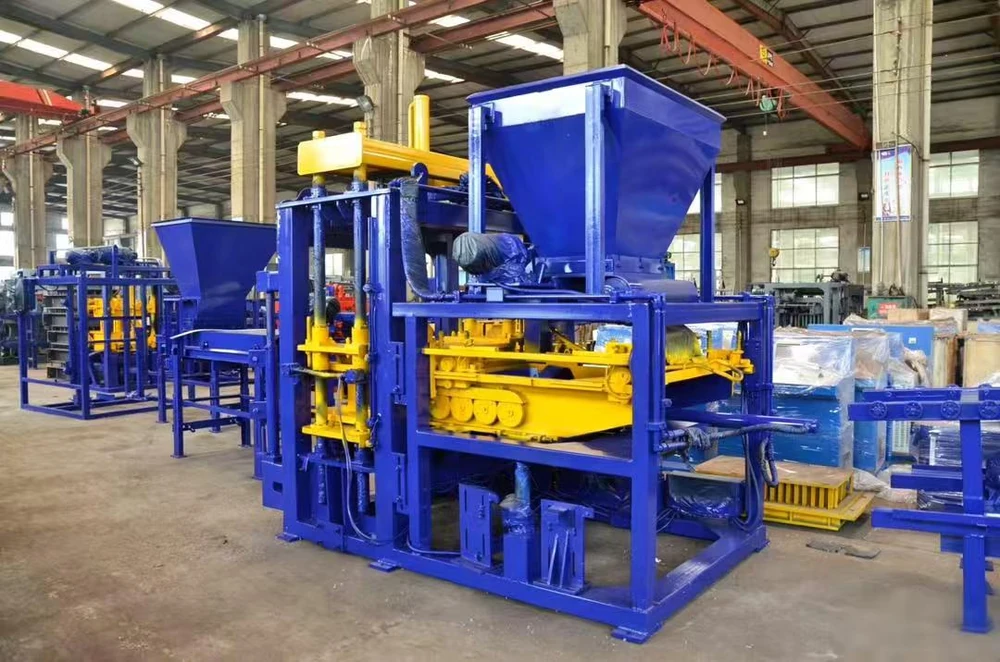
Manual vs. Semi-Automatic vs. Fully Automatic Machines
Automation directly dictates payroll costs and hourly output.
- Manual Block Making Machine:
- Operation: Hand levers control feed gates, compaction, and demolding.
- Capacity: Typically 500 to 1,500 standard units per 8-hour shift.
- Best for: Small DIY outfits, remote job sites, or regions with extremely cheap labor.
- Semi Automatic Block Machine:
- Operation: Hydraulics handle mold pressing, but workers manually control material feeding, lever-activated cycles, and pallet transport.
- Capacity: 3,000 to 6,000 blocks per shift.
- Best for: Expanding yards seeking consistent concrete block dimensions without massive capital overhead.
- Automatic Block Making Machine:
- Operation: Controlled via a central PLC system. Batching, mixing, feeding, vibration, pressing, and pallet stacking run automatically.
- Capacity: 8,000 to 20,000+ units per shift.
- Best for: Commercial plants requiring reliable high-volume output and minimal labor reliance.
| Automation Level | Daily Output (Blocks/8 hrs) | Labor Requirement | Capital Cost |
|---|---|---|---|
| Manual | 500 – 1,500 | 4 – 6 Operators | Very Low |
| Semi-Automatic | 3,000 – 6,000 | 3 – 5 Operators | Moderate |
| Fully Automatic | 8,000 – 20,000+ | 1 – 2 Operators | High |
Stationary Hydraulic Machines vs. Mobile Egg-Laying Models
The plant layout decides whether the machine stays anchored or moves across the yard.
- Stationary Hydraulic Machines:
These units bolt to a reinforced concrete foundation. The machine compresses the concrete block onto wooden, PVC, or steel production pallets. A stacker moves pallets directly to curing chambers.- Strengths: Multi-product capability (hollow blocks, solid bricks, interlocking pavers, curb stones) and unmatched compressive strength.
- Limitations: Requires pallets and dedicated curing space.
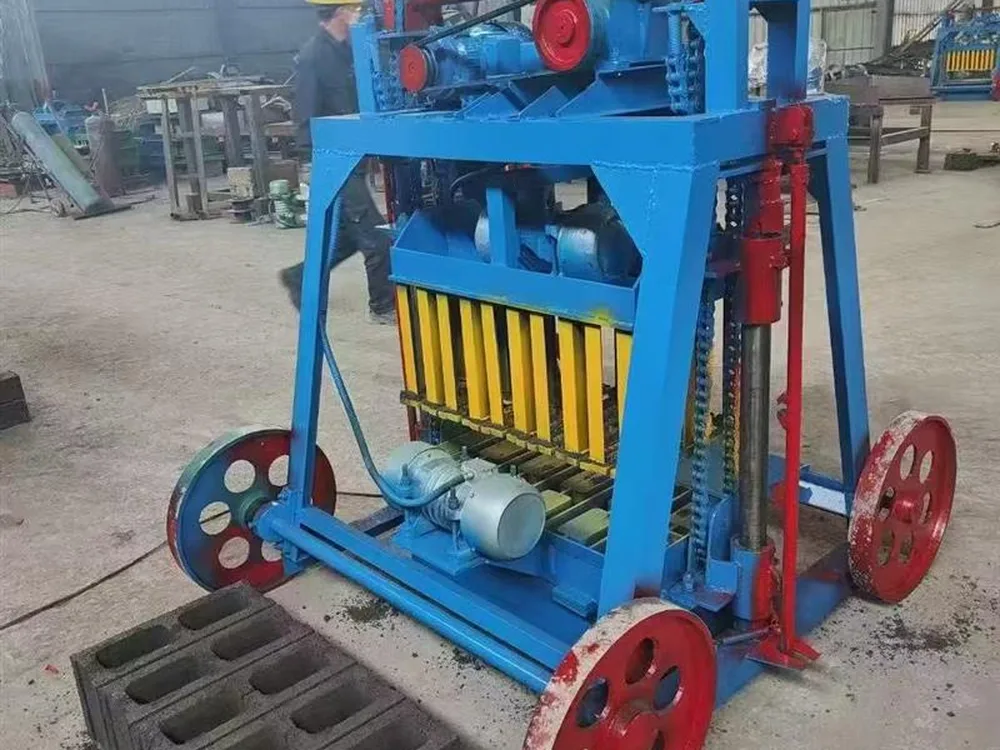
- Mobile Egg-Laying Models:
These self-propelled machines run on wheels directly over a flat concrete slab. They deposit blocks straight onto the ground, move forward, and drop the next batch.- Strengths: No production pallets needed; low entry cost.
- Limitations: Limited strictly to standard hollow and solid blocks. They require expansive concrete yards and expose fresh units to open weather.
Mechanical Vibration vs. High-Pressure Hydraulic Systems
Density determines whether a block passes building codes or crumbles under load. The compaction method makes all the difference:
- Mechanical Vibration Only:
Common on entry-level models, using simple eccentric counterweights on the mold box. While functional for basic partition blocks, vibration alone leaves microscopic voids, yielding lower compressive strength (often under 5–7 MPa) and higher water absorption rates. - High-Pressure Hydraulic Systems:
Industrial manufacturing pairs high-frequency directional vibration tables with dual hydraulic downward rams (often 15 to 25+ MPa pressure). This simultaneous dual-action force pushes trapped air out of coarse aggregates, bonding cement paste tightly to sand and gravel. The result is uniform density, razor-sharp edges, and compressive ratings exceeding 15 to 25 MPa—essential for load-bearing and municipal infrastructure specs.
Operational Feasibility: Questions 1 to 4 Before You Buy
Before committing capital to a commercial block machine, you must confirm whether your operational setup can support daily production. Investing in equipment without evaluating capacity needs, footprint, and utilities leads to idle machinery and wasted overhead.
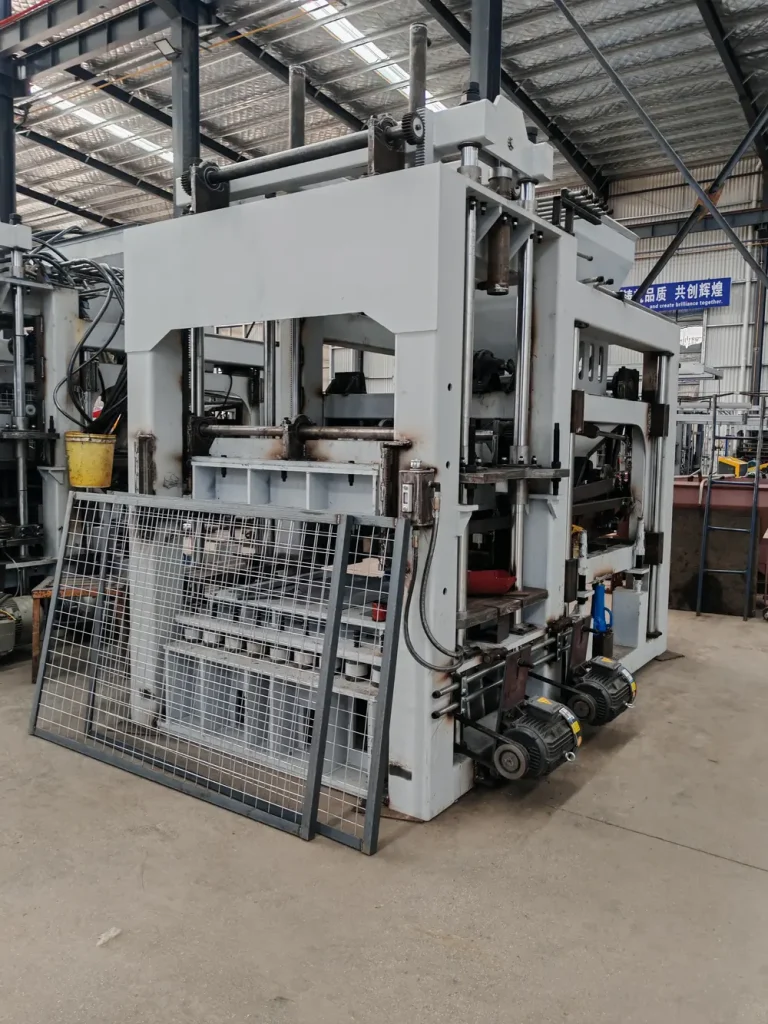
Question 1: What Daily Production Capacity Do You Actually Require?
Buying too small limits your growth, while buying too large burns cash on unutilized machinery. Calculate your target output based on realistic market demand rather than peak theoretical numbers.
- Match market demand: Review confirmed builder contracts, local retail demand, and your distribution reach.
- Understand cycle times: A machine boasting an 8-hour shift output must account for routine stops, mold cleaning, and mix preparation.
- Plan for scalability: Reviewing a detailed comparison between QT4-15, QT6-15, and QT8-15 machines helps you match your daily production capacity directly against standard factory outputs before you buy.
| Machine Category | Typical Shift Output (8 Hours) | Best Suited For |
|---|---|---|
| Small Semi-Automatic | 1,500 – 3,000 standard blocks | Startup yards and local retail |
| Mid-Range Automatic | 5,000 – 9,000 standard blocks | Commercial supply & municipal works |
| High-Volume Production Line | 10,000+ standard blocks | Large infrastructure & regional distribution |
Question 2: What Range of Blocks and Pavers Do You Plan to Produce?
A versatile machine safeguards your revenue when construction trends shift. Determine whether your business targets standard masonry, decorative landscaping, or heavy-duty civil projects.
- Standard masonry units: Hollow blocks, solid bricks, and lightweight insulated units.
- Interlocking pavers: Zig-zag, uni-pavers, and heavy-duty industrial dock pavers.
- Specialty products: Curbstones, retaining wall blocks, and water-permeable eco-pavers.
If decorative surfaces are part of your business model, consider key questions to ask before buying a paving block machine, particularly regarding secondary face-mix feeding systems that apply color and fine aggregates.
Question 3: Do You Have Adequate Land, Curing Space, and Infrastructure?
The concrete block making machine itself takes up only a small fraction of the required total area. Production efficiency collapses if you lack functional working zones.
- Raw material storage: Dedicated bays for sand, gravel, stone dust, and bulk cement silos.
- Curing yard: Fresh concrete blocks require 24 to 72 hours of protected curing before stacking, demanding significant yard space.
- Finished goods holding: Adequate clear zones to inventory pallets and maneuver forklifts safely.
- Traffic logistics: Wide access roads built to handle heavy 30-ton aggregate haulers and flatbed delivery trucks.
Question 4: Are Stable Water and Three-Phase Power Supplies Available?
Commercial block plants rely heavily on continuous industrial power and consistent water supply. Disruptions during batching or pressing ruin full mixes and cause expensive hydraulic lockups.
- Three-phase electrical grid: Verify that your site has stable industrial voltage (typically 380V–415V, 50/60Hz).
- Backup power generation: Factor in an industrial diesel generator if local grid supply suffers from frequent brownouts or load-shedding.
- Clean water access: High-grade blocks demand steady water pressure and clean, chemical-free water for proper cement hydration.
- Recycling setup: Installing a basic runoff basin allows you to reclaim washdown water and control site slurry effectively.
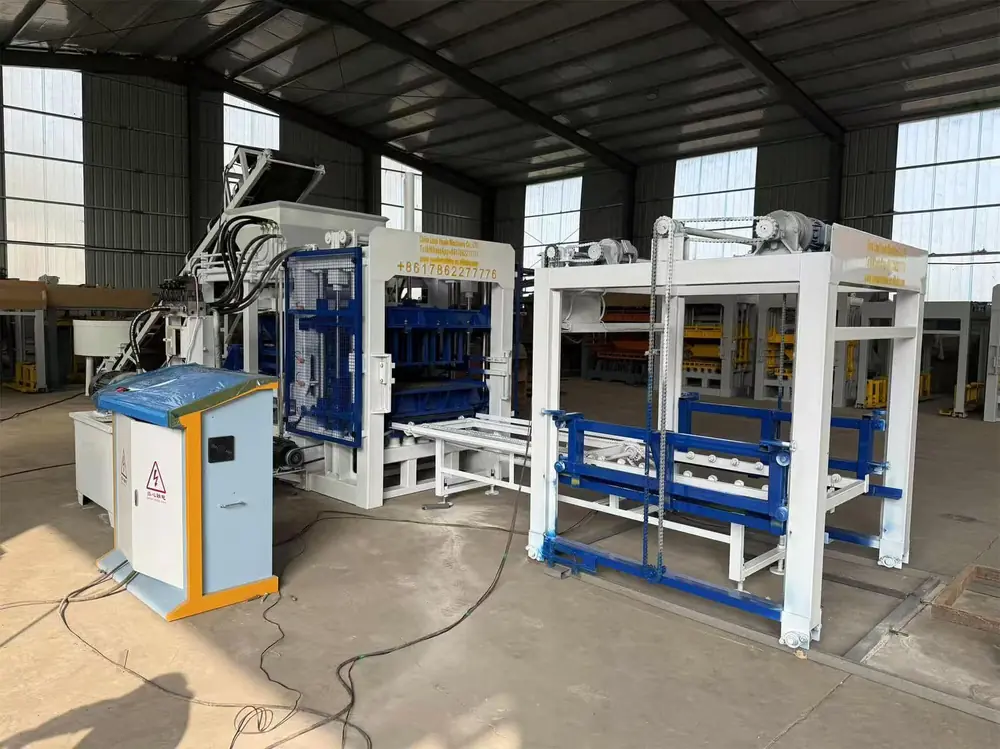
Materials and Technical Fit: Questions 5 to 8 Before You Buy
Getting the technical specifications right ensures your investment does not sit idle. Before selecting equipment, evaluate your aggregate sources, regional labor dynamics, and hardware longevity.
Question 5: Are Your Local Raw Materials Compatible with the Machine?
A block machine is only as good as the aggregate mix fed into it. Standard cement, sand, and crushed stone perform well in almost every unit, but alternative materials require specific mechanical setups:
- River sand and gravel: Standard aggregate requiring standard vibration.
- Fly ash and slag: Require high-tonnage hydraulic compression and precise moisture control. For specialized blends, review our fly ash brick machine guide to match aggregate density with hydraulic force.
- Quarry dust and volcanic cinder: Highly abrasive materials that demand hardened steel feeder boxes and wear-resistant liners.
Testing local raw materials in advance prevents structural cracks, weak compression ratings, and premature machinery wear.
Question 6: Which Level of Automation Fits Your Labor Costs and Skills?
Labor rates and local technical know-how dictate the optimal machine configuration:
| Machine Type | Typical Crew Size | Technical Skill Level | Best Fit For |
|---|---|---|---|
| Manual / Egg-Laying | 4–6 workers | Basic mechanical | Low-wage markets, remote sites |
| Semi-Automatic | 3–5 workers | Moderate operation | Growing yards balancing cost and output |
| Fully Automatic | 1–2 operators | PLC and electrical mastery | High labor cost areas, continuous output |
If skilled technicians are scarce in your area, an overly complex PLC setup creates unnecessary operational bottlenecks whenever a sensor trips.
Question 7: How Durable Are the Core Hydraulic and Electrical Components?
The structural frame lasts for decades, but the components driving the force determine your real uptime:
- Hydraulic valves and pumps: Standard valves risk rapid overheating and fluid leaks. Choose trusted brands (such as Yuken or Rexroth) that handle continuous 16–21 MPa pressures without pressure drops.
- Vibration motors: Dual-shaft or servo-driven vibration systems deliver dense concrete blocks without shaking the chassis apart.
- Electrical enclosures: Sealed IP54 or IP65 electrical cabinets keep fine cement dust away from sensitive relays, contactors, and PLC boards.
Question 8: How Difficult and Costly Is It to Swap Molds?
Diversifying product offerings—from standard hollow blocks to solid pavers and interlocking bricks—relies entirely on mold flexibility. Before buying, check:
- Changeover downtime: Standard designs take 2 to 4 hours to change, while quick-clamp systems take under 45 minutes.
- Heat treatment standards: Premium molds undergo carburizing and quenching to reach 60–62 HRC hardness, lasting beyond 100,000 cycles.
- Tooling expense: Factor in the initial cost of extra sets. Learning how to choose the right mold for your block making machine saves capital while matching immediate local building specifications.
Financial Realities: Questions 9 to 10 Before You Buy
The purchase price of a machine is only a fraction of the capital required to run a profitable production yard. If you only budget for the catalog price, cash flow shortages will halt operations before your first cured batch hits the market.
Question 9: What Is the True Total Cost of Ownership Beyond the Sticker Price?
The initial invoice for a block machine accounts for roughly 40% to 60% of your startup capital. True Total Cost of Ownership (TCO) spans continuous operational inputs and supporting hardware that many first-time producers overlook:
- Production Pallets: Whether you choose bamboo, PVC, or GMT composite pallets, buying the initial batch of 1,000 to 2,000 pallets represents a major direct cost.
- Auxiliary Equipment: A functional setup demands wheel loaders, cement silos, screw conveyors, batching plants, and forklifts to transport cured stacks.
- Wear Parts & Consumables: Vibration box bearings, mold liner plates, scraper blades, and hydraulic filter elements require scheduled replacements.
- Operating Utilities: Heavy-duty hydraulic motors and continuous vibrators draw substantial kilowatt-hours, alongside thousands of gallons of daily curing water.
Before committing, balance these numbers against the equipment’s rated output. Comparing options across the 10 best cement block machines rated by output and price will help you align capital outlay with practical operational limits.
Question 10: What Is Your Projected Payback Period and ROI?
A viable commercial setup must pay for itself within 8 to 18 months. Calculating an accurate Return on Investment (ROI) requires balancing real-world capacity against conservative local sales numbers:
$Daily Net Margin = (Selling Price per Unit – Raw Material & Production Cost) × Daily Output$
Do not calculate ROI based on theoretical 100% efficiency. Instead, calculate your cash flow at 60% to 70% capacity to account for raw material delays, rainy seasons, and standard maintenance downtime. A high-efficiency automatic block making machine delivers exceptional margins through low labor overhead, while a entry-level semi automatic block machine minimizes initial debt exposure for emerging markets.
| Investment Tier | Typical Equipment Class | Target Payback Window | Minimum Daily Utilization |
|---|---|---|---|
| Entry Level | Manual / Light Mechanical | 4 – 8 Months | 80% (High labor dependency) |
| Mid Scale | Semi-Automatic Hydraulic | 8 – 14 Months | 65% (Balanced overhead) |
| Industrial Scale | Fully Automated Production Line | 12 – 20 Months | 50% (High capital recovery threshold) |
Factoring in Shipping, Import Duties, and Installation Expenses
The landed cost of imported equipment frequently exceeds the FOB (Free on Board) quotation by 25% to 45%. International sea freight fluctuates, and heavy stationary equipment demands standard 20-foot or 40-foot HQ containers, or open-top units for heavy mechanical presses.
To avoid budget shortfalls, review our comprehensive block machine China to Africa import guide detailing tariffs, port clearing routines, and logistics logistics planning.
Budget separately for local port clearance, customs value-added taxes (VAT), inland road transport, crane offloading, and the reinforced concrete foundation required to isolate ground vibration. Finally, allocate funds for factory technician accommodation, visa processing, and daily commissioning stipends to ensure your concrete block production line is dialed in, calibrated, and operational without delays.
Supplier Reliability: Questions 11 to 12 Before You Buy
Choosing the right equipment matters, but choosing the right supplier matters even more. When you set up a concrete block plant, the vendor you partner with determines whether your production line runs smoothly or sits idle waiting for basic assistance.
Question 11: Is the Seller a True Manufacturer or a Trading Intermediary?
Before wiring a deposit, confirm whether you are speaking directly to the factory floor or dealing with a third-party broker. Middlemen often markup prices by 15% to 30% and lack direct technical control over custom molds or mechanical adjustments.
| Factor | Direct Equipment Manufacturer | Trading Company / Broker |
|---|---|---|
| Pricing | Factory-direct rates with transparent margins | Marked up to cover broker commissions |
| Technical Customization | Direct engineering changes to molds and hydraulics | Limited capability; acts only as an echo chamber |
| Spare Parts Sourcing | Original molds and CNC-machined parts readily stocked | Slower sourcing; dependent on external suppliers |
| Warranty Execution | Immediate dispatch of replacements and engineers | Multi-layered communication delays |
Working directly with an original plant ensures direct engineering accountability. For global logistics breakdowns and supplier vetting standards, consult our block machine procurement guide to avoid costly middleman pitfalls.
Question 12: How Accessible Are Spare Parts and On-Site Technical Support?
Downtime kills profitability. Every hour your block machine sits idle due to a blown hydraulic seal, a burnt solenoid valve, or a cracked vibration spring chips away at your working capital.
- Wear Parts Availability: Ensure high-wear items—such as tamper head liners, mold shoes, proximity switches, and hydraulic filters—ship with the initial container.
- Component Standardization: Prioritize machinery built with universally accessible electrical components (such as Siemens PLCs or Schneider contactors) that you can easily source from local industrial supply shops.
- Remote and On-Site Commissioning: Verify if the supplier provides overseas technician dispatch for mechanical setup, electrical calibration, and local operator training.
- Response Windows: Require a guaranteed response timeframe (under 24 hours) for technical troubleshooting via remote video diagnostics.
Verifying Certifications, Factory Audits, and Live Trial Runs
Never buy industrial equipment based on glossy catalog photos alone. Insist on hard proof of build quality before releasing production balances.
- Live Video Factory Audits: Request an unedited, real-time video walkthrough of the fabrication facility, the CNC machining centers, and the assembly floor.
- Dry and Wet Testing: Demand a video recording of your actual machine undergoing a full dry run (cycling without material) and a wet batch test to check mold ejection, vibration frequency, and hydraulic pressure stability.
- Structural Certification: Verify standard CE marks, ISO 9001 quality management compliance, and mill test certificates for heavy steel plate frames.
Common Pitfalls to Avoid When Buying a Block Machine
Setting up a manufacturing plant requires substantial capital. Too many operators rush their purchasing decisions, blinded by attractive unit prices or inflated output figures, only to face bottlenecked cash flow and idling equipment months later. Avoiding these classic mistakes protects your balance sheet and ensures your operation stays profitable.
Overestimating Demand and Purchasing Excess Capacity
The fastest way to drain capital is buying a machine designed to produce far more units than your target market can absorb. Running a high-volume setup at only 30% of its rated output drives up your cost per block through unabsorbed depreciation, high idle-power consumption, and stranded capital.
- Assess realistic local consumption: Calculate verifiable regional demand, not optimistic projections.
- Match plant scale to immediate off-take: Evaluate the QT10-15 block machine capacity and ROI against your verified sales channels before stepping up to mega-scale commercial plants.
- Preserve cash flow: Start with an output rate that matches your immediate distribution network, expanding shift hours or adding modules only when sustained order volume demands it.
Ignoring Wear Parts and Daily Maintenance Schedules
Concrete is abrasive. Every cycle wears down molds, tamper heads, pallet feeders, and guide shafts. If you don’t budget for consumable replacements or enforce basic maintenance discipline, your plant will suffer sudden shutdowns, irregular block dimensions, and weak compressive strength.
| Wear Component | Failure Consequence | Prevention Protocol |
|---|---|---|
| Mold Liners | Dimensional drift, jagged edges | Inspect weekly; replace every 80,000–120,000 cycles |
| Vibration Shaft Bearings | Inadequate compaction, weak concrete | Grease every shift using high-temp industrial lubricant |
| Hydraulic Seals & Filters | Fluid contamination, slow cycle times | Replace filters every 500 operating hours; check seals monthly |
Daily wash-downs prevent wet aggregate from caking into moving linkages, and scheduled grease runs keep downtime planned rather than catastrophic.
Compromising on Steel Quality and Hydraulic Brand Reliability
A cheap frame built from sub-standard structural steel flexes under continuous vibration, misaligning the tamper head and cracking weld seams within months. Cutting corners on core hydraulics is equally damaging. Cheap directional valves stick when oil warms up, and low-grade pumps lose pressure, directly resulting in soft, poorly formed blocks.
When choosing between mechanical drives or pressure systems, understanding how hydraulic vs mechanical block machines handle heavy duty cycles helps avoid costly breakdowns. Insist on structural steel built with heavy-gauge Q355B or manganese alloys, paired with globally serviced hydraulic components from trusted names like Yuken, Rexroth, or Parker. Reliable steel and proven valves maintain consistent cycle speeds, tight dimensional tolerances, and high structural integrity across every production shift.