
Are you struggling to choose the best production equipment for your brick-making business?
Investing in the wrong setup can quickly drain your budget and stall your daily output. The truth is, your profitability comes down to matching your local labor, space, and volume goals with the right technology.
That’s why we’ve broken down the 6 types of cement block machines explained below—giving you an honest, no-fluff guide to discover exactly which is right for you.
Let’s dive right in.
Understanding Cement Block Machines: Key Benefits and Fundamentals
What Is a Cement Block Machine and How Does It Work?
A cement block machine is an industrial manufacturing system engineered to compress and mold concrete mixtures into durable, uniform construction units. The equipment handles diverse raw materials—primarily a sand and cement mix, crushed stone, fly ash, and slag—transforming them into high-load-bearing structural blocks.
[Raw Materials: Sand, Cement, Aggregates]
↓
[High-Shear Mixing]
↓
[Hydraulic & Vibration Molding]
↓
[Dense, Cured Blocks]
The operation relies on four core stages:
Batching and Mixing: Raw materials are blended with precise water ratios to form a cohesive, semi-dry concrete mix.
Feeding: The mixture is fed automatically or manually into high-precision steel molds.
Vibration and Hydraulic Compression: The machine applies simultaneous vertical pressure and intense vibration to eliminate air voids and maximize block density.
Demolding and Ejection: Formed green blocks are demolded onto pallets or directly onto the factory floor for curing.
Key Advantages of Investing in Modern Concrete Block Equipment
Upgrading to modern concrete block making machine technology significantly reduces operating overhead while improving construction standards across global markets.
| Operational Factor | Traditional / Manual Methods | Modern Block Machinery |
|---|---|---|
| Output Speed | 200–500 units / day | 2,000–30,000+ units / day |
| Density & Strength | Variable; prone to internal voids | High compression; uniform load-bearing |
| Labor Requirement | High manual intervention | Minimal (automated feeding and stacking) |
| Product Versatility | Limited to single shapes | Multi-functional (interlocking, hollow, solid) |
| Material Efficiency | Higher waste rate (>8%) | Minimal waste (<1% via precise batching) |
Key Business Benefits:
Consistent Structural Integrity: Controlled hydraulic force delivers uniform compressive strength that meets stringent international building standards.
Lower Unit Cost: High-throughput production dramatically reduces the labor and energy cost per unit.
Market Flexibility: Fast mold-change systems allow you to switch production between standard hollow blocks, solid bricks, and decorative pavers on the same machine line.
Sustainable Production: Fully compatible with industrial by-products like fly ash, bottom ash, and quarry dust, minimizing raw material costs.
6 Main Types of Cement Block Machines Explained
Choosing the right equipment depends on your daily production targets, budget, and local operating conditions. We have broken down the six primary configurations available on the market today to help you match the right machine to your production goals.
1. Manual Cement Block Machines
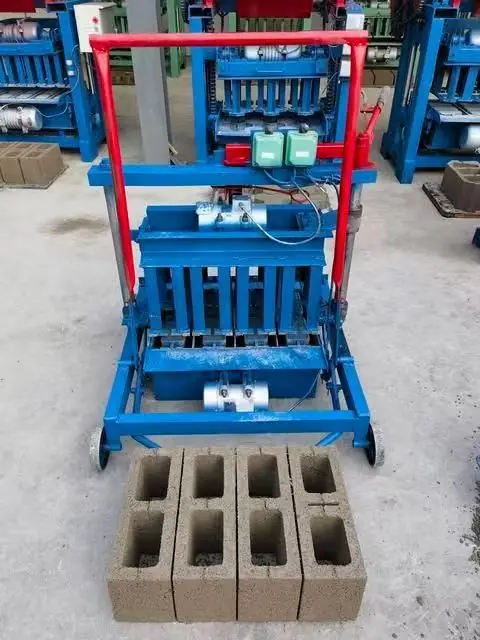
A manual block making machine is the simplest and most accessible entry point for small-scale operations and startup businesses.
- How it works: Operators manually feed the sand and cement mix into the mold, compress the unit using a hand-operated mechanical lever, and demold the blocks by hand.
- Best suited for: Small-scale builders, rural communities, and micro-enterprises with low daily demand (typically 500 to 1,200 blocks per day).
- Key benefits: Extremely low capital investment, zero or minimal electrical requirement, and low maintenance overhead.
2. Semi-Automatic Concrete Block Machines
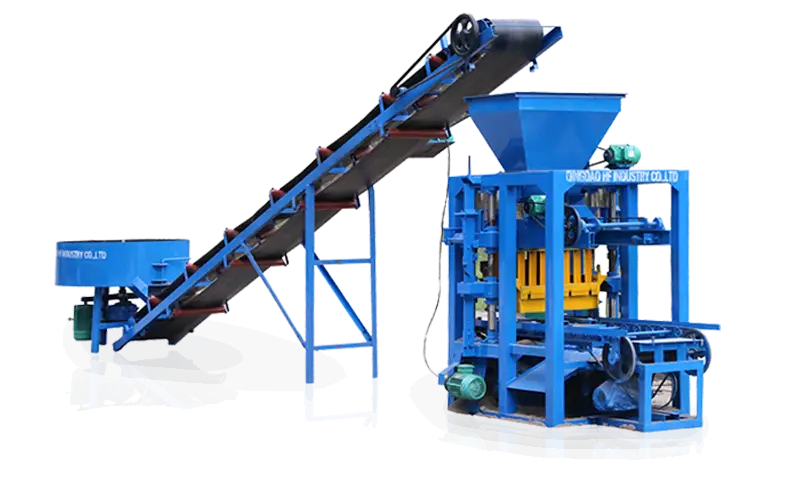
A semi-automatic brick machine combines human control with mechanical and hydraulic power to boost daily volume. For an in-depth breakdown of operational economics, check out our concrete block machines types, operation, and ROI guide.
- How it works: Raw material mixing and feeder transport are mechanized, while operators control hydraulic compression and demolding using manual valve levers.
- Best suited for: Growing commercial block yards aiming for balanced daily output without investing in complex computer-controlled lines.
- Key benefits: Excellent balance of labor efficiency, high compaction pressure, and moderate startup costs.
3. Fully Automatic Cement Block Production Lines
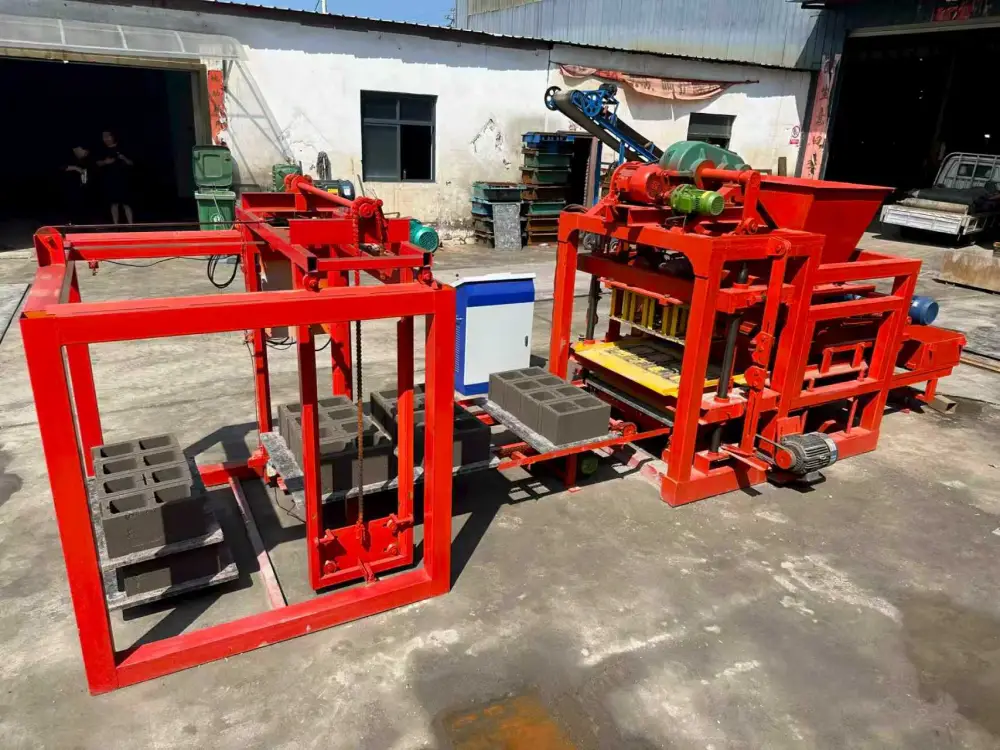
A fully automatic production line delivers maximum capacity, consistency, and labor reduction through complete PLC automation.
- How it works: The entire sequence—from aggregate batching, mixing, and pallet feeding to mold compression and green block stacking—runs on an automated cycle controlled via an integrated touchscreen panel.
- Best suited for: Large commercial suppliers, municipal infrastructure projects, and high-volume commercial masonry suppliers.
- Key benefits: Minimal manual labor, fast cycle times (15–25 seconds per drop), and highly uniform block density and finish.
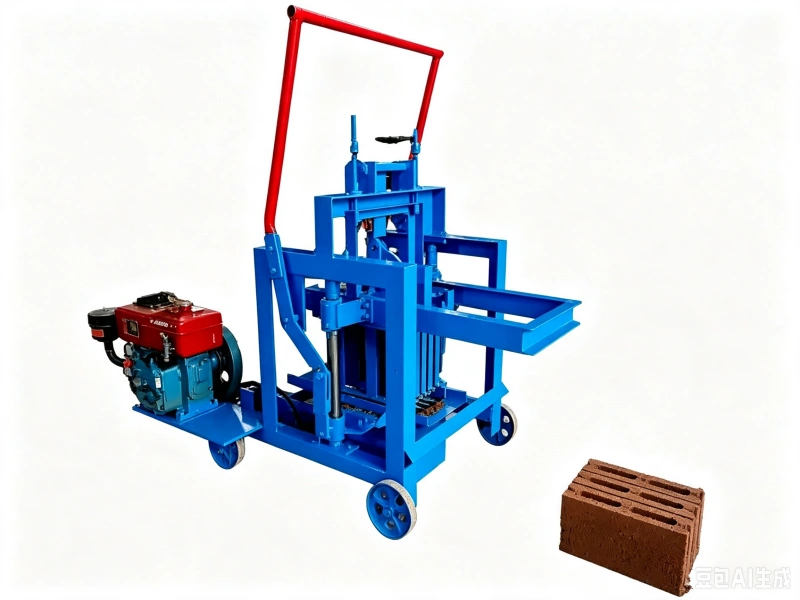
4. Mobile (Egg-Laying) Block Machines
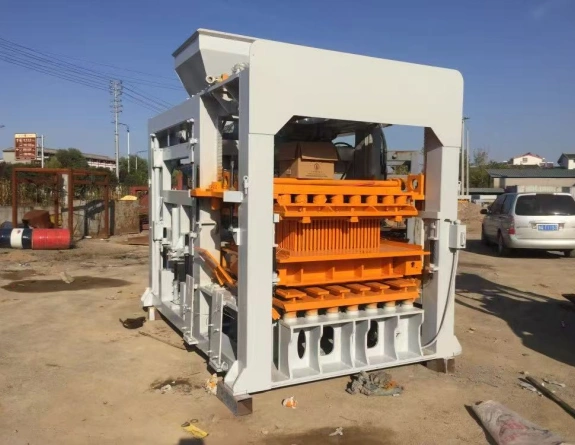
A mobile egg layer machine moves along a flat concrete slab, dropping finished blocks directly onto the ground as it travels.
- How it works: The unit molds, vibrates, and demolds blocks directly onto the production floor, then advances forward to start the next cycle without using production pallets.
- Best suited for: Operations with extensive flat ground space wanting to avoid the capital cost of hundreds of wooden or PVC production pallets.
- Key benefits: Eliminates pallet investment costs, simple mechanical layout, and rapid demolding turnaround.
5. Stationary Hydraulic Block Making Machines
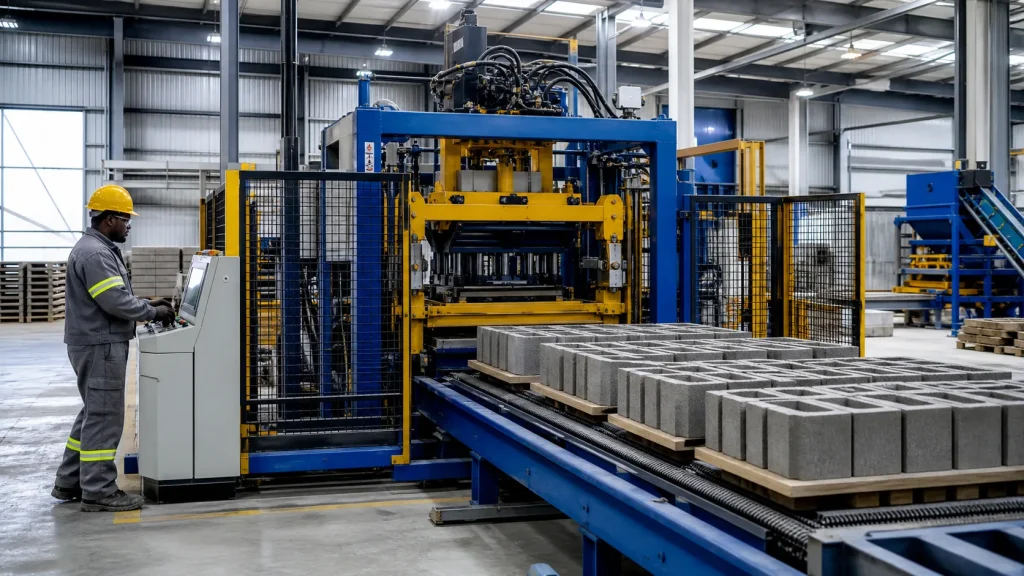
A hydraulic block maker uses a rigid stationary frame and high-pressure hydraulic cylinders to deliver maximum structural density. You can explore how these units perform in our review of the 10 best cement block machines rated by output and price.
- How it works: High-tonnage hydraulic force pairs with high-frequency table vibration to tightly compress aggregates inside a stationary mold box using standardized production pallets.
- Best suited for: Producers manufacturing load-bearing structural blocks, heavy-duty interlocking pavers, and decorative masonry.
- Key benefits: Unmatched compressive strength, sharp edges on finished goods, and versatile mold-changing capabilities.
6. Diesel-Powered Cement Block Machines
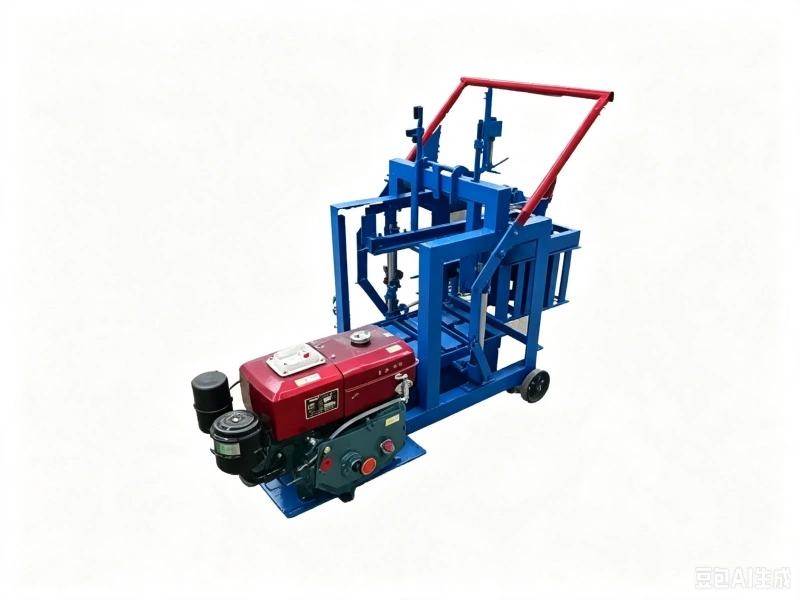
A diesel powered block maker provides an independent power source, making it ideal for regions with unstable power grids or remote job sites.
- How it works: An integrated diesel engine powers the hydraulic pumps, mechanical vibrators, and transmission systems directly, removing the need for a three-phase electrical utility connection.
- Best suited for: Remote construction sites, roadwork projects, and rural block yards where utility power is unavailable or cost-prohibitive.
- Key benefits: Complete energy independence, field mobility, and reliable continuous operation in challenging environments.
Key Mold Types and Block Profiles You Can Produce
One of the biggest strengths of our concrete block making equipment is mold interchangeability. By simply swapping the precision-engineered molds, you can switch production lines within hours and cater to diverse construction demands without investing in separate machinery.
Hollow and Solid Concrete Blocks
Standard masonry units form the backbone of commercial and residential construction projects worldwide. Utilizing a balanced sand and cement mix along with fine aggregates, you can produce several high-demand profiles:
- Standard Hollow Blocks: Designed with two or three hollow cores to reduce weight and improve thermal insulation. If your primary market focuses on lightweight, high-demand structural units, exploring our detailed hollow block making machine guide will give you deeper insight into mold configurations and output capacities.
- Solid Load-Bearing Blocks: Dense, heavy-duty masonry units engineered for high-compressive-strength applications, foundations, and retaining structures.
- Cinder and Lightweight Blocks: Produced using lightweight aggregate or fly ash mixes, ideal for non-load-bearing partition walls.
Interlocking Paving Bricks
Paving blocks require high density and precise edges to handle continuous vehicle and pedestrian traffic. With high-pressure hydraulic vibration, our machines yield tightly compacted pavers with crisp geometry:
- Uni-Pavers and Zig-Zag (Holland) Bricks: High interlock capability for heavy-traffic areas like ports, roads, and container terminals.
- Hexagonal and Wave Pavers: Popular choices for urban walkways, driveways, and commercial plazas.
- Color Face-Mix Pavers: By adding a secondary face-mix feeding system, you can produce double-layer decorative pavers with colored pigments and textured top layers at minimal extra cost.
Kerbstones and Landscape Blocks
Heavy infrastructural elements require extreme durability and rigid dimensional tolerances. Specialized molds allow you to produce large-format concrete profiles efficiently:
| Product Category | Common Applications | Key Mold Characteristics |
|---|---|---|
| Road Kerbstones | Highway borders, drainage channels, municipal street edges | Heavy-duty steel molds with high wear resistance; vertical or horizontal demolding |
| Retaining Wall Blocks | Slope stabilization, garden terracing, structural earth retention | Textured split-face molds with built-in interlocking rear lips |
| Lawn & Garden Edging | Parks, residential landscapes, decorative pathways | Custom aesthetic profiles for rapid, mortarless dry-stack installation |
Every mold is heat-treated and precision-machined using carbonized steel to guarantee consistent dimensional accuracy across hundreds of thousands of production cycles.
Essential Supporting Equipment for a Complete Production Line
A standalone concrete block making machine is only as productive as the system supporting it. To run a profitable, continuous operation, pairing your core forming unit with properly matched auxiliary equipment eliminates bottlenecks and keeps your cycle times fast.
Batching and Mixing Systems
Getting the right material proportions is the foundation of high-strength masonry units. Consistent raw materials feed directly into product durability and lower cement consumption.
- Aggregate Batching Machines: Automatic hopper batchers accurately weigh sand, gravel, and crushed stone before feeding them forward.
- Twin-Shaft or Planetary Mixers: Standard drum mixers cannot handle dry-cast concrete. Forced planetary or twin-shaft mixers homogenize the dry sand and cement mix with minimal water in under three minutes.
- Cement Silos and Screw Conveyors: Bulk cement storage paired with automated screw feeders cuts raw material labor costs while keeping dust contained.
Conveyors and Block Stacking Equipment
Smooth material transfer prevents wet block deformation and keeps the forming station running at peak speed.
- Belt Conveyors: Heavy-duty rubber belt conveyors transfer the mixed aggregate smoothly from the mixer to the block machine hopper without material segregation.
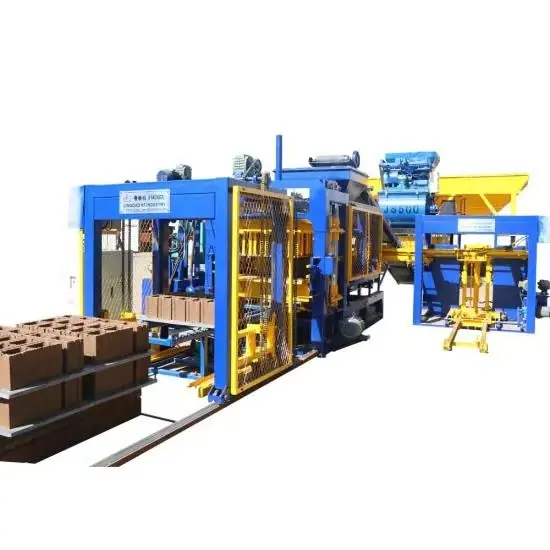
- Automatic Block Stackers: Fresh blocks exiting the machine need careful handling. An automatic block stacker lifts and tiers multiple production pallets vertically, readying them for transport. If you are configuring a fully automatic production line, an integrated stacker is essential for maintaining high throughput without manual intervention.
Curing and Palletizing Systems
The final stage determines the finished compressive strength and packaging efficiency of your concrete products.
| Equipment Component | Primary Function | Operational Advantage |
|---|---|---|
| Curing Racks / Chambers | Holds fresh blocks in controlled humidity for 24 hours | Prevents edge cracking and speeds up initial hardening |
| Automatic Block Cubber / Palletizer | Clamps cured blocks and stacks them directly onto wooden shipping pallets | Eliminates manual sorting and cuts packaging labor by up to 70% |
| Pallet Return Conveyor | Cleans, turns, and feeds steel/fiber pallets back into the block machine | Protects pallet longevity and automates the mold feed cycle |
For medium to large-scale setups, balancing these auxiliary units with high-output machinery like the QT6-15 concrete block machine ensures seamless material flow from raw aggregate to wrapped, ready-to-ship product cubes.
How to Choose the Right Cement Block Machine for Your Business
Selecting the ideal cement block machine comes down to aligning equipment capabilities with your market demand, budget, and operational constraints. Making the right investment ensures fast payback, minimal downtime, and consistent product quality.
Evaluating Production Capacity and Daily Output Targets
Your daily target dictates the scale and technology of the machine you need. Calculate your expected volume based on actual client orders, local construction activity, and raw material availability.
| Machine Category | Typical Daily Output (8-hour shift) | Best Suited For |
|---|---|---|
| Manual Block Making Machine | 500 – 1,200 blocks | Small DIY projects, remote sites, micro-businesses |
| Semi-Automatic Brick Machine | 2,000 – 6,000 blocks | Growing commercial suppliers, localized sales |
| Fully Automatic Production Line | 8,000 – 25,000+ blocks | Large-scale infrastructure, regional distribution |
Matching output to demand avoids underutilizing expensive stationary block equipment or overworking a smaller unit beyond its design limit. If you are launching a startup in a developing region, finding the best cement block machine for small business helps keep initial capital expenditure low while leaving room for future expansion.
Balancing Automation Levels with Local Labor Costs
The degree of automation directly controls labor overhead, cycle speed, and output uniformity:
- High Labor Cost Markets: A fully automatic concrete block making machine delivers maximum ROI. It minimizes manual handling from batching to stacking, keeping operating costs predictable.
- Low Labor Cost Markets: A semi-automatic setup often provides the fastest path to profitability. Operators manage pallet transfer while the hydraulic block maker handles high-pressure compaction for consistent block density.
- Versatility via Tooling: Ensure the base machine supports quick tool changes. Learning how to choose the right mold for your block making machine allows you to switch between standard hollow blocks, solid pavers, and interlocking bricks with minimal downtime.
Factory Space and Infrastructure Requirements
A profitable block manufacturing plant requires well-planned infrastructure beyond the machine itself:
- Power Supply: Industrial automatic lines require a stable 3-phase grid connection. For locations with unreliable electricity, a diesel powered block maker ensures uninterrupted daily runs.
- Yard Space for Curing: Freshly pressed concrete units need 24 to 48 hours of mist curing and up to 28 days of curing space for peak compressive strength. Dedicate at least 60% of your total land area for pallet transit and block storage.
- Raw Material Storage: Position sand, gravel, and bulk cement storage bins close to the batching plant to streamline feed cycles and reduce material transport delays.
- Floor Leveling & Foundation: Heavy hydraulic equipment demands reinforced concrete foundations to absorb vibration and maintain precise mold alignment over years of continuous operation.
Frequently Asked Questions About Cement Block Machines
Can One Block Machine Produce Different Types and Sizes of Blocks?
Yes. Modern cement block machines use interchangeable mold systems to create various concrete products on a single unit. Swapping out the mold lets you switch production seamlessly between different profiles:
- Hollow building blocks (stretcher, corner, and double-corner units)
- Solid concrete bricks for standard masonry and load-bearing walls
- Interlocking pavers in zig-zag, uni-decor, and wave patterns
- Curbstones and grass pavers for roadwork and landscaping
Switching standard molds takes roughly 20 to 45 minutes on modern hydraulic systems, giving you the flexibility to adapt your product catalog to local construction demand without buying extra machinery.
What Is the Cost Difference Between Semi-Automatic and Fully Automatic Machines?
The upfront investment depends heavily on automation grade, hydraulic force, and line integration. Partnering directly with a verified block machine distributor for automatic block machines helps businesses source complete systems with optimal price-to-performance ratios.
| Machine Category | Typical Price Range (USD) | Labor Needed per Shift | Key Advantages |
|---|---|---|---|
| Semi-Automatic Machine | $8,000 – $25,000 | 4 – 7 Workers | Lower entry cost, simple maintenance, ideal for small-to-medium startups. |
| Fully Automatic Production Line | $35,000 – $120,000+ | 1 – 2 Workers | High continuous output, precise PLC batching, lower long-term labor costs. |
Semi-automatic setups are cost-effective for regional supply operations, while fully automatic plants maximize profit margins in high-volume, continuous manufacturing environments.
How Do Mold Quality and Vibration Power Affect Block Strength?
Final compressive strength and surface finish depend directly on mold craftsmanship and compaction dynamics:
- Mold Steel & Heat Treatment: High-grade manganese alloy steel treated with carbonitriding resists abrasive sand-cement mixes. This maintains precise dimensional tolerances over 100,000+ production cycles without edge deformation.
- Dual-Directional Vibration: Synchronized top-and-bottom table vibration shakes out air pockets in seconds. This liquefies the dry-mix aggregate, ensuring solid particle packing.
- Hydraulic Pressure Integration: Combining high-frequency vibration with multi-ton hydraulic compression delivers high-density blocks that pass standard commercial load tests while using optimal cement ratios.