
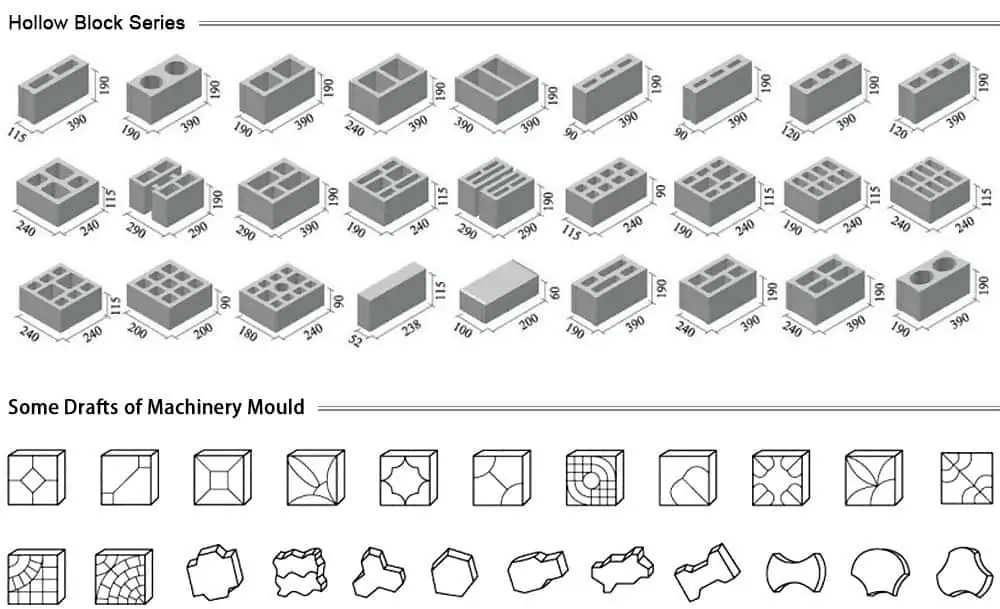
Different block types — all produced by interchangeable molds on the same machine
Your block making machine is only as versatile as the molds inside it. The right mold determines what you can produce, how fast you can produce it, and ultimately, how profitable your block-making business will be. Choose the wrong mold and you’ll be stuck making products nobody wants to buy. Choose the right one, and a single machine can serve dozens of different markets.
In this guide, we’ll walk you through everything you need to know about block machine mold selection — from understanding the different mold types available, to evaluating mold material quality, to maintaining your molds for maximum lifespan. Whether you’re buying your first machine or expanding your product line, this guide will help you make the right choice.
What Is a Block Machine Mold?
A block machine mold — sometimes called a “mould” or “die” — is the replaceable metal form that shapes concrete, cement, or fly ash into specific block types. The mold sits inside the machine’s vibration table. Raw material fills the mold cavity, the hydraulic press head compresses it, vibration removes air pockets, and the formed block is pushed out onto a pallet.
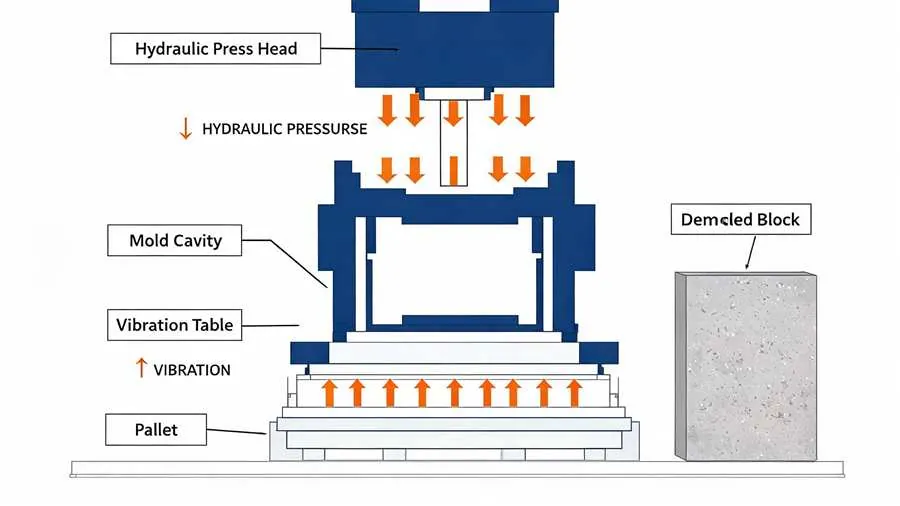
Cross-section: how a block machine mold assembly works — from hydraulic press to demolded block
Every QT4-15, QT6-15, and QT8-15 machine supports interchangeable molds. This means you can produce hollow blocks today, switch to pavers tomorrow, and make curb stones next week — all on the same machine, just by changing the mold.
Key takeaway: One machine + multiple molds = multiple revenue streams. Don’t think of molds as accessories — think of them as product lines.
Types of Block Machine Molds
Block machine molds come in many shapes and sizes. Here are the most common types you’ll encounter:
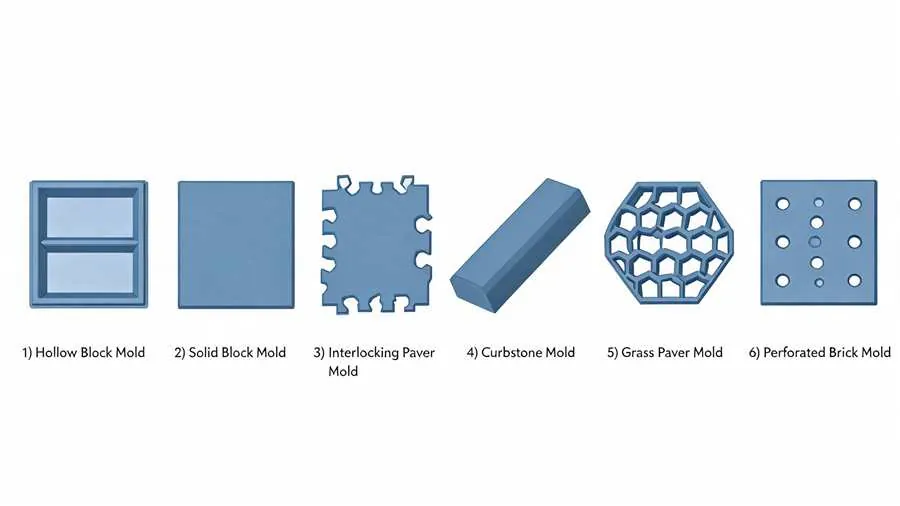
Six common mold types — each produces a different block for different construction needs
1. Hollow Block Molds
The most widely used mold type, especially in Africa and Southeast Asia. Hollow blocks have voids that reduce weight and material cost while maintaining structural strength. Common sizes include 400×200×200mm (4-inch), 400×200×150mm, and 600×200×200mm. If you’re serving the residential construction market, this is your bread-and-butter mold. Learn more about hollow block production.
2. Solid Block Molds
Solid blocks have no voids — they’re dense, heavy, and used for load-bearing walls, foundations, and retaining structures. Solid block molds are simpler in design but require more material per block. They’re popular in areas where maximum strength is needed, such as industrial foundations and road barriers.
3. Paver / Interlocking Molds
Paving block molds produce interlocking tiles, cabro stones, and decorative pavers used for driveways, walkways, and public squares. These molds have intricate shapes — zigzag patterns, hexagons, rectangles with interlocking edges — and typically produce thinner blocks (60mm, 80mm, or 100mm thick). Paver molds are among the most profitable because paving stones sell at a premium compared to hollow blocks.
4. Curbstone Molds
Curb stones (also called kerb stones) are long, heavy blocks used for road edges, sidewalk borders, and drainage channels. Curbstone molds produce blocks typically 500×300×150mm or 750×300×150mm. These molds are essential if you’re bidding on municipal road projects or large estate developments.
5. Grass Paver Molds
Grass pavers (also called “grasscrete” or “turf block”) have a honeycomb or grid pattern that allows grass to grow through the block. They’re used for eco-friendly parking lots, slope protection, and garden pathways. While not the highest-volume product, grass paver molds can serve a profitable niche market with less competition.
6. Perforated Brick Molds
Perforated bricks are smaller than hollow blocks and have circular holes through the body. They’re commonly used in wall construction where a smoother finish is desired. These molds produce more blocks per cycle due to the smaller size — 8 to 12 bricks per cycle on a QT6-15 machine.
6 Factors to Consider When Choosing a Mold
Choosing a mold isn’t just about block type. Here are six factors that should guide your decision:
| Factor | What to Ask | Why It Matters |
|---|---|---|
| Block Dimensions | What sizes are standard in my market? | Blocks that don’t match local building codes won’t sell |
| Production Volume | How many blocks of this type do I need per day? | Determines if you need a single mold or multiple cavities |
| Material Compatibility | Will my cement-sand mix work with this mold? | Some molds require specific aggregate sizes or mix ratios |
| Mold Material | Is it carburized heat-treated steel? | Harder molds last longer and maintain dimensional accuracy |
| Custom vs Standard | Do I need a non-standard block size? | Custom molds cost more but open unique market opportunities |
| Maintenance Ease | How easy is it to clean and inspect? | Molds that are hard to clean slow down production |
Mold Material Quality: What to Look For
Not all molds are created equal. The material quality of your mold directly affects its lifespan, the surface finish of your blocks, and your total cost of ownership. Here’s what to check:
Carburizing Heat Treatment
Quality molds undergo carburizing heat treatment, which hardens the surface of the steel to HRC 58-62 while keeping the core tough and resistant to cracking. This creates a wear-resistant surface that can withstand hundreds of thousands of production cycles. Low-quality molds skip this step — they’re cheaper upfront but wear out 3-5x faster.
CNC Wire Cutting
Premium molds are cut using CNC wire EDM (Electrical Discharge Machining), which ensures dimensional accuracy to within ±0.1mm. This precision matters because uneven mold surfaces cause blocks to stick during demolding, leading to breakage and production slowdowns. All Wojin molds use CNC wire cutting.
Surface Finish
The inside walls of the mold should be smooth and polished. Rough surfaces cause friction during demolding, which can damage blocks and wear the mold faster. Run your finger along the inside of a quality mold — it should feel like polished metal.
Hardness Testing
Ask your supplier for the mold’s hardness rating. A good mold should have a surface hardness of at least HRC 55. Anything below that will show visible wear within the first 50,000 cycles.
Pro tip: When buying a machine, ask the supplier what molds are included free of charge. Wojin Machinery includes free molds with every concrete block machine purchase — and additional molds can be ordered at competitive prices.
How to Change Molds Quickly
One of the biggest advantages of modern block machines is the quick-change mold system. On machines like the QT4-15 and QT8-15, changing a mold takes 30-45 minutes — a process that used to take half a day on older machines.
Here’s the basic process:
- Power off the machine and relieve hydraulic pressure
- Remove the upper press head bolts (typically 4-6 bolts)
- Lift out the upper press head using the built-in lifting hooks
- Unbolt the lower mold box from the vibration table
- Remove the old mold and insert the new one
- Rebolt and reconnect any hydraulic lines
- Run 2-3 test cycles to verify alignment
With practice, a trained operator can complete the entire changeover in under 30 minutes. This means you can switch from hollow blocks to pavers in the morning and back to hollow blocks in the afternoon — giving you maximum production flexibility.
Mold Maintenance: Extending Mold Life
A quality mold should last 100,000+ cycles with proper maintenance. Without it, you might be replacing molds after just 20,000 cycles. Here are the essential maintenance practices — many of which are covered in our 10 maintenance tips for cement block machines:
Daily Cleaning
After each shift, clean the mold cavities with a wire brush to remove cement residue. Built-up material changes the block dimensions and causes demolding friction. For stubborn residue, use a pneumatic chisel carefully — don’t damage the mold surface.
Regular Oiling
Apply a thin layer of mold release oil to the cavity walls before each shift. This reduces friction during demolding and prevents concrete from sticking. Use a proper mold release agent — not motor oil or grease, which can degrade the mold surface over time.
Weekly Inspection
Inspect the mold for signs of wear: rounded edges, surface scratches, dimensional changes. Use calipers to check that block dimensions are still within tolerance. If blocks are coming out 1-2mm larger or smaller than specified, the mold is wearing out.
Proper Storage
When a mold is not in use, clean it thoroughly, apply a rust-preventive oil, and store it in a dry, covered area. Molds left exposed to moisture will rust — and rust pits on the mold surface will damage every block you produce afterward.
Common Mold Problems and Solutions
| Problem | Likely Cause | Solution |
|---|---|---|
| Blocks stick in mold | Insufficient mold release oil | Apply oil before each cycle; check mold surface finish |
| Blocks have rough edges | Mold wear or damage | Inspect mold edges; resurface or replace if worn |
| Inconsistent block height | Mold misalignment | Realign mold on vibration table; check bolts |
| Blocks too heavy or light | Wrong material mix for mold type | Adjust cement-to-aggregate ratio |
| Mold rusting | Improper storage | Clean and oil mold; store in dry area |
| Cracked mold frame | Excessive hydraulic pressure | Reduce press pressure; check machine settings |
Most mold problems are preventable with regular maintenance. If you’re starting a block machine business, train your operators to spot these issues early — catching a problem at the mold stage saves thousands of wasted blocks.
Cost of Replacement Molds
Replacement molds are an investment, not an expense. Here’s what you can expect to pay:
| Mold Type | Price Range (USD) | Expected Lifespan |
|---|---|---|
| Hollow block mold (4-cavity) | $800 – $1,500 | 100,000+ cycles |
| Solid block mold (6-cavity) | $700 – $1,200 | 120,000+ cycles |
| Paver/interlocking mold | $900 – $1,800 | 80,000+ cycles |
| Curbstone mold | $1,000 – $2,000 | 90,000+ cycles |
| Grass paver mold | $1,200 – $2,200 | 70,000+ cycles |
| Custom mold (non-standard) | $1,500 – $3,500 | 80,000+ cycles |
Prices vary based on mold complexity, material quality, and supplier. At Wojin Machinery, all molds are made from carburized heat-treated steel with CNC wire cutting — ensuring maximum lifespan and consistent block quality.
Need a custom mold or replacement?
We manufacture molds for all block types and machine models — including custom dimensions to match your local market requirements. All molds include a quality guarantee and free shipping with machine orders.
Get Mold PricingFrequently Asked Questions
Can I use the same mold on different machine models?
No. Molds are designed for specific machine models because the pallet sizes, vibration table dimensions, and hydraulic press specifications differ between models. A QT4-15 mold won’t fit a QT8-15 machine and vice versa. However, molds are interchangeable within the same model family — for example, all QT4-15 machines use the same mold mounting system.
How many molds should I buy with my machine?
We recommend starting with at least 2-3 molds: one for hollow blocks (your highest-volume product), one for pavers (your highest-margin product), and one for a specialized product like curb stones or solid blocks. You can always add more molds later as your market expands. Wojin Machinery includes free molds with every machine purchase — contact us to discuss your needs.
How long does a block machine mold last?
A quality mold with carburizing heat treatment should last 100,000+ production cycles with proper maintenance. That’s roughly 1-2 years of continuous production. Lower-quality molds without heat treatment may need replacement after 20,000-30,000 cycles. Regular cleaning, oiling, and proper storage are the most important factors in extending mold life.
Can I get a custom mold for a non-standard block size?
Yes. We manufacture custom molds for non-standard block dimensions. Custom molds cost more ($1,500–$3,500 depending on complexity) and take 15-25 days to produce, but they allow you to serve niche markets with less competition. Send us your block dimensions and we’ll provide a quote within 24 hours.
Conclusion
Choosing the right mold for your block making machine is about more than just block shape — it’s about matching your production to your market, maximizing your machine’s versatility, and investing in quality that pays off over time. The right mold combination can turn a single machine into a multi-product factory, serving residential, commercial, and municipal construction markets simultaneously.
Remember these key principles:
- Start with your market — find out what blocks sell best in your area before choosing molds
- Invest in quality — carburized heat-treated molds cost more upfront but last 3-5x longer
- Maintain religiously — daily cleaning and oiling can double your mold’s lifespan
- Plan for growth — start with 2-3 molds and expand as your customer base grows
At Wojin Machinery, we’ve helped hundreds of entrepreneurs in 60+ countries choose the right molds for their block machines. Every machine we sell comes with free molds, and we offer custom mold manufacturing for any block dimension you need.
Discuss Your Mold Requirements