
What Production Capacity and Daily Output Do You Need?
Selecting the right paving block making machine starts with a precise evaluation of current contract demands and future growth targets. Investing in an oversized concrete block machine leads to unnecessary capital expenditure, while an undersized unit risks project delays and lost revenue.
Calculating Daily Block Output and Production Demands
To accurately estimate the required daily output volume, align equipment specifications with practical operational conditions rather than theoretical maximums.
- Forming Cycle Time: High-efficiency paver block machines complete a cycle in 15 to 25 seconds.
- Blocks Per Mold: Calculate the number of standard paving units produced per vibration cycle.
- Operating Hours: Standard planning relies on an 8-hour shift calculated at 80% practical efficiency to account for batching and routine maintenance.
| Production Scale | Standard Pavers / Mold | Output Per Hour | Target Daily Volume (8-Hr Shift) |
|---|---|---|---|
| Small Scale | 4 – 8 pcs | 800 – 1,200 pcs | 5,000 – 8,000 pcs |
| Medium Scale | 10 – 18 pcs | 2,000 – 3,500 pcs | 15,000 – 25,000 pcs |
| Large Industrial | 24 – 42 pcs | 5,000 – 8,000 pcs | 35,000 – 60,000+ pcs |
Choosing Between Stationary and Mobile Machine Types
Job site logistics and plant infrastructure determine whether a stationary or mobile paving block making machine delivers the highest return on investment.
- Stationary Block Machines:
- Best For: High-volume, centralized industrial manufacturing.
- Key Advantages: Delivers higher hydraulic compaction force, uniform block density, secondary face-mix color integration, and seamless coupling with automated cubing systems.
- Mobile Block Machines:
- Best For: On-site manufacturing, temporary setups, and regional infrastructure projects.
- Key Advantages: Eliminates production pallet investments by depositing molded blocks directly onto a paved curing floor, significantly lowering initial setup capital.
Which Machine Automation Level Fits Your Operation?
Choosing the right automation level directly impacts your daily output, labor costs, and overall profit margins. I always evaluate local labor availability and upfront capital against long-term production goals before locking in a machine specification.
Fully Automatic Paving Block Machines
A fully automatic block making machine delivers maximum efficiency with minimal human intervention. Controlled by integrated PLC systems, these setups handle everything from aggregate batching and mixing to block molding and stacking.
- Best For: Large-scale commercial producers and high-volume industrial suppliers.
- Key Advantages: Consistent block quality, peak daily throughput, and reduced labor overhead.
- Consideration: Requires higher initial capital investment. Working directly with an established block machine distributor for automatic block machines guarantees seamless system integration and operator training.
Semi-Automatic Paving Block Machines
A semi-automatic block machine hits the sweet spot between upfront investment and operational speed. Operators handle material loading or pallet transfer, while hydraulic pressing and vibration remain fully motorized.
- Best For: Growing block yards and mid-sized construction enterprises.
- Key Advantages: Lower entry cost than fully automated lines, paired with reliable output and quick mold changes.
- Consideration: Requires a steady workforce to maintain consistent shift cycles. Reviewing a comprehensive concrete block machines types, operation, and ROI guide helps clarify exact labor needs and output expectations.
Manual Block Making Machines
Manual units rely on hand-operated levers and mechanical force for material feeding, compaction, and block discharge.
- Best For: Small startup operations, rural projects, or micro-businesses testing local demand.
- Key Advantages: Lowest initial purchase price, basic mechanical maintenance, and zero dependence on complex electronics.
- Consideration: Lower daily output volume and potential variations in block density depending on operator consistency.
What Molds and Block Types Can the Machine Produce?
A single paving block making machine can yield dozens of different concrete products simply by changing the mold set. Product versatility dictates how fast your plant adapts to shifting market demands and contractor requirements.
Interlocking Paver and Custom Mold Compatibility
Quick mold changes keep your production line responsive. A high-performing paver block machine supports both standard structural shapes and specialized architectural designs without requiring massive machinery downtime.
| Block Category | Primary Applications | Mold Engineering Features |
|---|---|---|
| Interlocking Pavers | Driveways, walkways, commercial plazas | High-density wear resistance, tight edge tolerances |
| Hollow & Solid Blocks | Load-bearing walls, foundations | High height precision, uniform core dimensions |
| Curbstones & Grass Blocks | Roadside infrastructure, eco-parking lots | Large footprint molds, heavy-duty structural steel |
| Custom Architectural Pavers | Landscaping, custom contractor projects | Quick-swap mold plates, intricate surface textures |
Choosing a versatile automatic block making machine with modular mold frames reduces swap times from hours to minutes, preserving daily output volumes.
Secondary Processing and Color Surface Options
Adding premium value to basic concrete pavers requires surface treatment systems. Modern block production lines integrate secondary processing options directly into the workflow:
- Face-Mix System (Double Layering): Applies a fine color surface layer on top of a standard coarse aggregate base, reducing expensive pigment material costs while improving top surface appearance.
- Shot Blasting & Bush-Hammering: Textures the exposed surface to create an anti-slip, natural stone finish targeted at premium municipal projects.
- Curling & Polishing: Delivers a high-gloss, smooth surface finish for high-end architectural paving contracts.
What Raw Materials and Auxiliary Equipment Are Required?
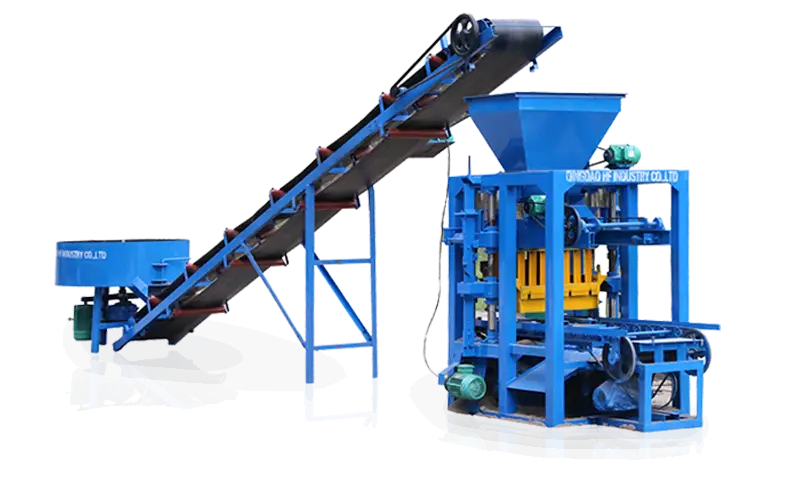
Buying a high-capacity paving block making machine is only half the equation. To keep your plant running at peak efficiency, your machine must match your local raw material availability and integrate seamlessly with upstream auxiliary equipment.
Aggregate, Cement, and Fly Ash Material Compatibility
A versatile paver block machine should easily process a wide range of raw materials, including sand, crushed stone, quarry dust, cement, and industrial byproducts.
- Mix Design Flexibility: Test whether the machine handles coarse sand, fine aggregates, and varying moisture levels without clogging the feeder box.
- Cost-Saving Byproducts: Incorporating fly ash or slag cuts material costs significantly while maintaining compressive strength. Check out our cement brick making machine raw materials guide to optimize your mix ratios for maximum profitability.
- Specialized Mixes: If your plant relies heavily on eco-friendly inputs, review our fly ash brick machine guide to ensure your feeding mechanism can handle fine-particle additives efficiently.
Dosing, Mixing, and Concrete Batching Plant Integration
In modern concrete block production, manual feeding creates bottlenecks and leads to inconsistent block quality. Your paving block machine requires a well-matched batching line to reach its rated daily output.
- Automatic Batching Plant: Weighs aggregate, cement, and water with high precision to guarantee uniform block density and color batch after batch.
- Planetary or Twin-Shaft Mixer: Rapidly mixes dry and semi-dry concrete to deliver a homogeneous blend before it hits the block mold.
- Belt Conveyors & Cement Silos: Streamline raw material transport directly into the machine hopper, lowering labor overhead and minimizing ambient dust in your factory.
What Are the Machine’s Build Quality and Technical Specifications?
Build quality directly impacts machine lifespan, product density, and maintenance downtime. Evaluating a paving block making machine requires looking closely at frame rigidity, hydraulic power, vibration synchronization, and automation controls.
Hydraulic System Pressure and Vibration Frequency
High compressive strength in pavers comes from combining precise hydraulic pressure with synchronized high-frequency vibration. When reviewing block machine specifications and features, these technical parameters set reliable industrial equipment apart from lower-grade options:
| Component / Metric | Ideal Technical Range | Operational Impact |
|---|---|---|
| Hydraulic System Pressure | 16–21 MPa | Delivers dense compaction for heavy-load, high-strength pavers |
| Vibration Frequency | 3,000–4,500 r/min | Rapidly releases trapped air voids to maximize block structural integrity |
| Structural Frame | Heavy-duty alloy steel | Absorbs intense mechanical stress and prevents structural frame distortion |
Automated Handling, Cubing, and PLC Control Systems
A modern automatic block making machine relies on integrated electronics and automated material handling to maximize output while minimizing labor costs:
- Programmable Logic Controllers (PLC): Smart PLC systems store multi-product recipes, track cycle times in real time, and enable remote diagnostic support.
- Automatic Stacking and Cubing: Automated palletizers move cured concrete blocks directly into tight cubes for transport, cutting manual labor and preventing edge breakage.
- Precision Sensors: Advanced proximity switches regulate hydraulic fluid movement and mold alignment to guarantee consistent paver dimensions.
What Is the Total Investment, Operating Cost, and Projected ROI?
Calculating the true financial commitment for a paving block making machine requires looking past the equipment sticker price. I always evaluate initial capital expenditures alongside ongoing operational costs to build a clear, accurate profitability model.
Paving Block Machine Price and Setup Expenses
The purchase price of a paver block machine represents just one portion of your total startup budget.
- Base Machinery Cost: Scales directly with machine size, build quality, and automation level.
- Shipping and Import Taxes: Freight charges, customs clearance, and local transportation fees for heavy machinery.
- Site Preparation: Reinforced concrete foundations, covered curing zones, and raw material storage bays.
- Installation and Setup: On-site technician support, electrical hookups, and initial test runs.
Labor, Energy, and Maintenance Cost Factors
Daily operating expenses determine your long-term profit margins on every unit produced. To accurately project your per-block margins, review my breakdown on how much does it cost to make a concrete block.
- Labor Overhead: Fully automated production lines require fewer workers, significantly lowering payroll costs.
- Power Consumption: High-pressure hydraulic systems and heavy-duty vibration motors consume regular electricity.
- Maintenance and Wear: Mold liners, tamper heads, and hydraulic filters require ongoing maintenance to keep production smooth.
Financial Planning and Profitability Analysis
A practical ROI analysis balances overall project costs against your expected daily output volume and local market prices. Reviewing regional pricing structures through a detailed block making machine price guide provides clear benchmarks for initial outlay versus projected revenues.
| Expense Category | Primary Cost Drivers | Business Impact |
|---|---|---|
| Capital Investment | Machine price, site prep, utility connections | Sets the initial payback horizon (typically 12–18 months) |
| Operating Costs | Cement, aggregates, electricity, labor | Directly controls profit margins per square meter of pavers |
| Production Efficiency | Machine uptime, shift counts, batch speeds | Maximizing daily output volume accelerates overall ROI |
How to Select a Reliable Block Machine Manufacturer?
Finding the right machinery manufacturer is just as critical as choosing the equipment itself. A high-performing paving block making machine requires stable production standards, strong engineering backing, and a manufacturing partner who understands global operational demands.
Evaluating Manufacturer Experience and Certifications
I always advise evaluating a supplier’s track record thoroughly before committing your capital. Experienced manufacturers bring years of technical refinement to their paver block machine designs, ensuring fewer operational breakdowns and superior structural longevity.
Key factors to evaluate include:
Industry Track Record: Look for established producers with verified global client installations and proven field performance.
International Certifications: Ensure compliance with ISO9001 quality management standards and CE safety certifications.
In-House R&D and Manufacturing: Select suppliers who design, cast, and test their concrete block machine models in their own facilities.
When launching or expanding a plant, partnering with a proven manufacturer makes starting a block machine business successfully far smoother and more predictable.
After-Sales Service, Warranty, and Spare Parts Support
Unplanned machinery downtime directly impacts daily output volume and profitability. That is why robust after-sales support is a non-negotiable requirement when purchasing an automatic block making machine or semi-automatic setup.
Essential service components to confirm before purchase:
Clear Warranty Terms: Comprehensive coverage on hydraulic systems, structural frames, and PLC electrical controls.
Fast Spare Parts Availability: Immediate access to standard wear items like mold liners, hydraulic seals, and vibration mounts.
Technical Assistance: Access to remote support, on-site commissioning, and comprehensive machine operator training.
If you are sourcing equipment for high-growth markets, evaluating regional market benchmarks like the top-performing cement block machines for sale in Africa helps ensure you choose a brand known for durable build quality and responsive field service.