
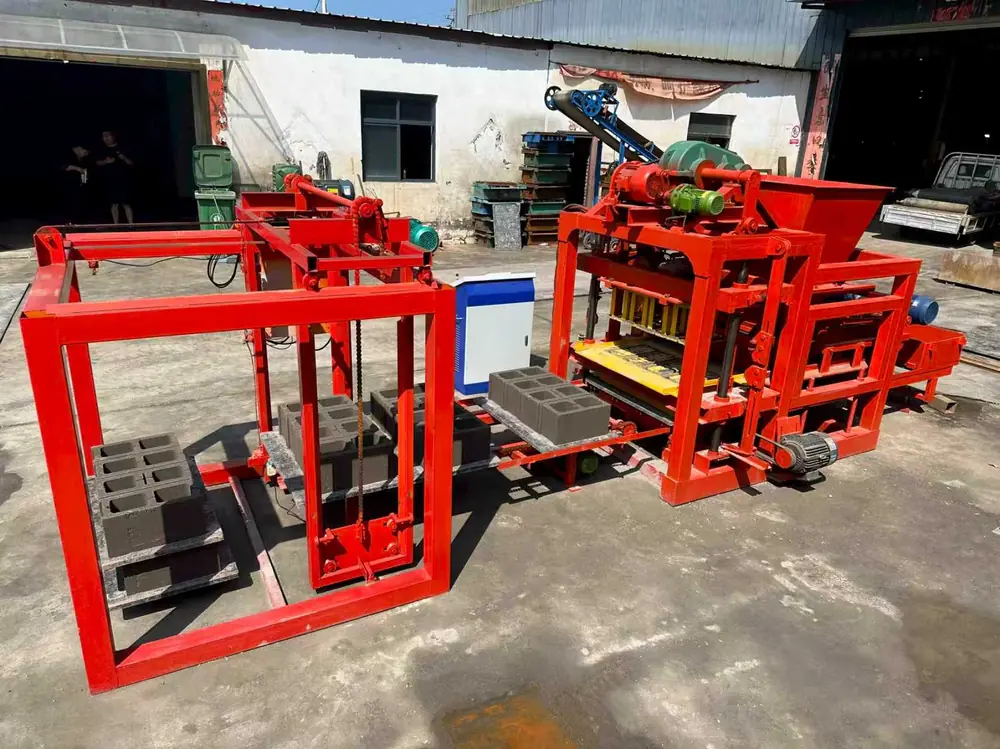
QT4-25 semi-automatic block making machine — one of the best-selling models for small to medium block factories
If you are thinking about starting a block making business or upgrading a small manual operation, you have probably heard of the QT4-25 semi-automatic block machine. It is one of the most popular mid-range models on the market today — and for good reason.
In this full technical review, we take a close look at the QT4-25: how it works, what it can produce, how much it costs, and whether it is the right choice for your factory. We cover everything from hydraulic system specifications to real-world production output.
Quick Summary
The QT4-25 is a semi-automatic hydraulic block machine that produces 4,500–5,200 hollow blocks per 8-hour shift. It costs between $5,000 and $8,000 USD from a direct manufacturer. It is ideal for small to medium block factories that want better output than manual machines but are not yet ready for a fully automatic line.
Our rating: 4.2 / 5.0 — Excellent value for money.
What Is the QT4-25 Block Machine?
The QT4-25 is a semi-automatic concrete block making machine. It uses hydraulic pressure combined with vibration to form concrete blocks. The “QT” stands for “Quangong Type” — a widely used design that many manufacturers build around.
Unlike fully automatic machines like the QT4-15 or QT6-15, the QT4-25 requires some manual work. Workers feed materials into the hopper and move pallets by hand. But the actual block forming is done by hydraulic pressure and vibration — automatically.
This makes the QT4-25 a popular “step-up” machine for businesses that currently use manual machines but want higher output without spending $15,000+ on a fully automatic model.
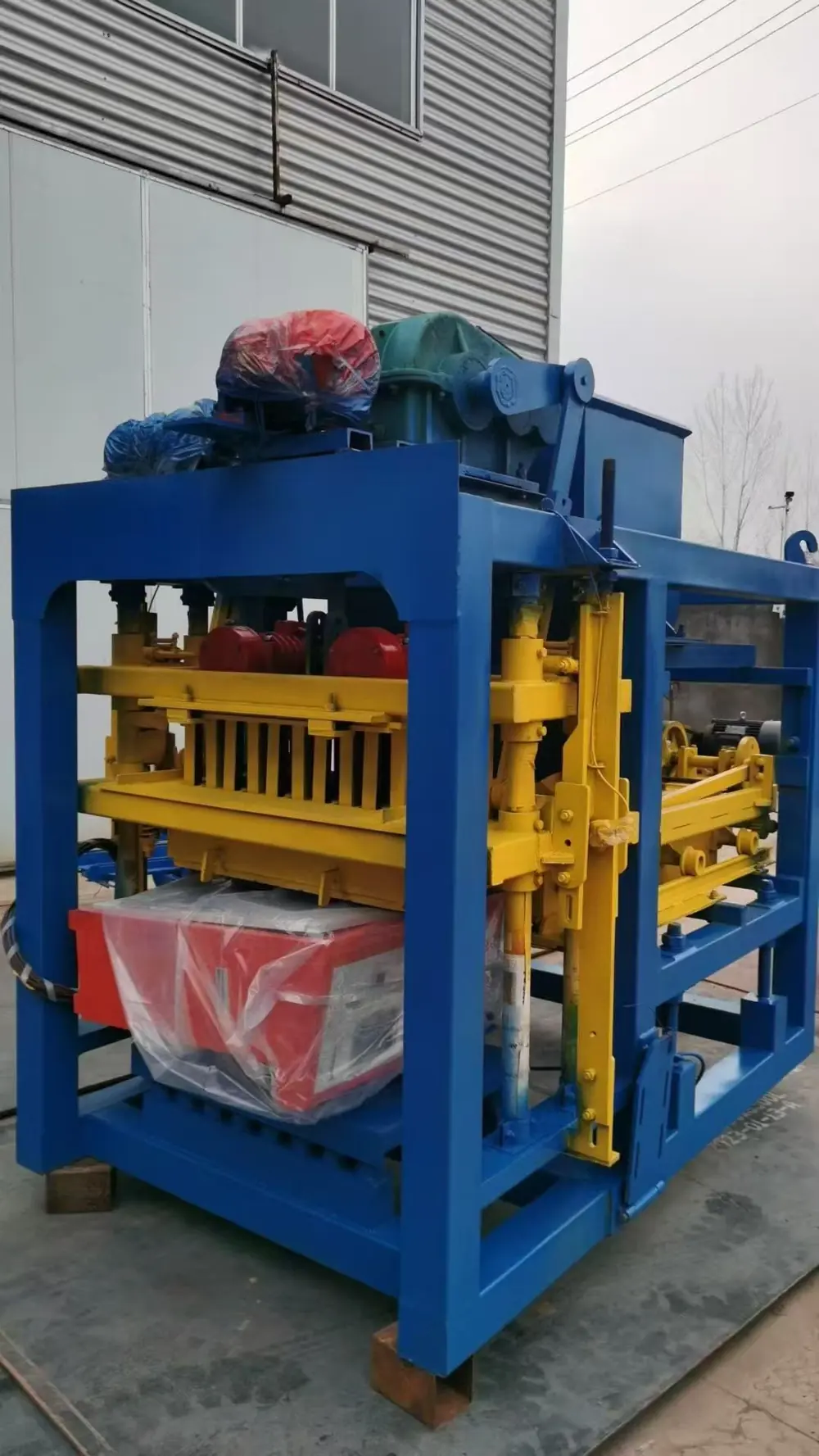
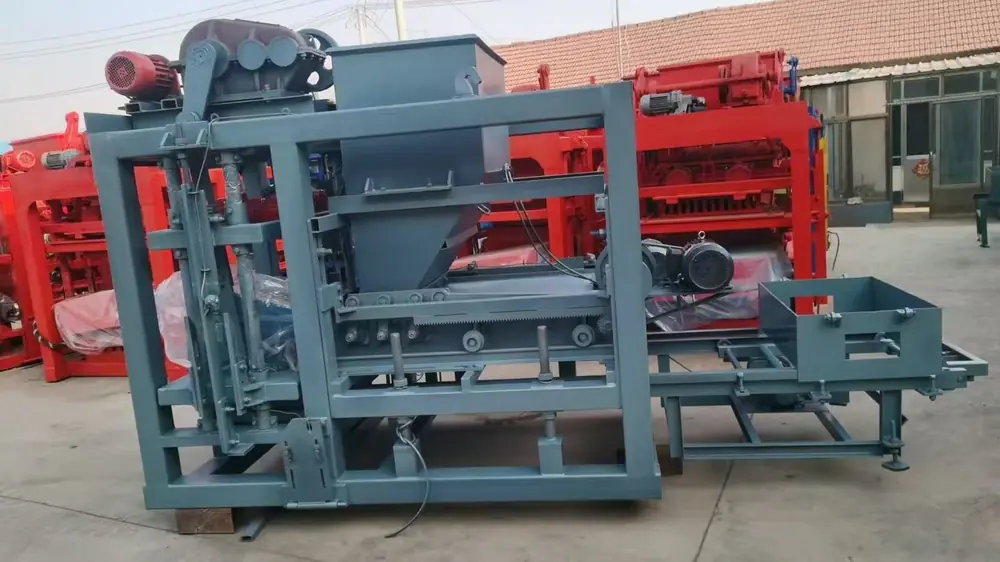
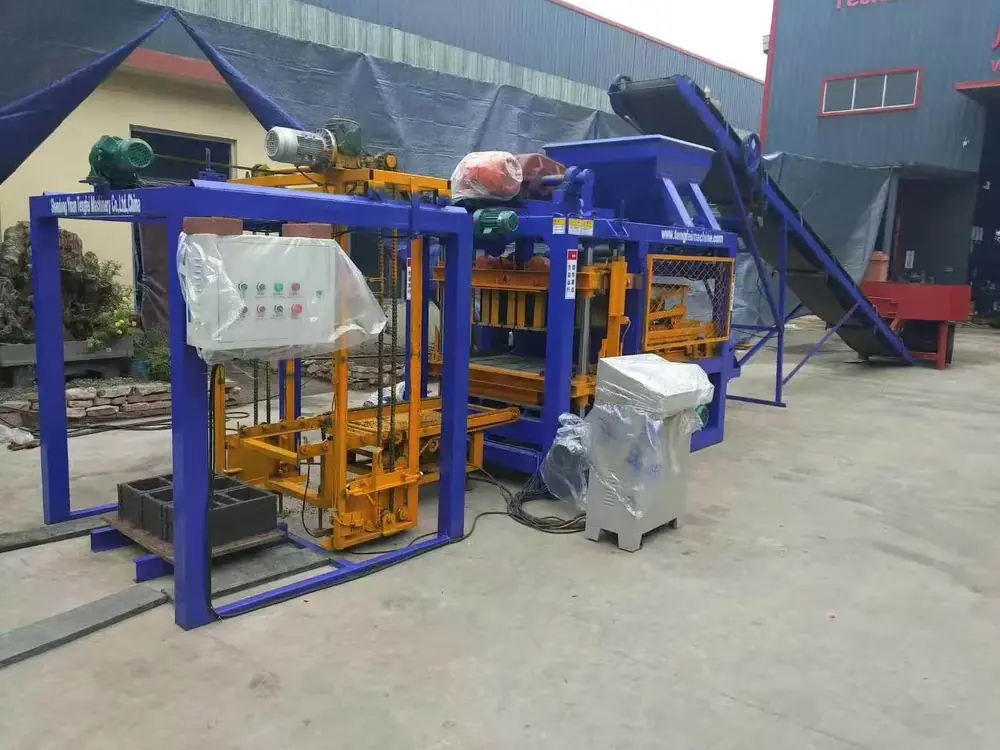
Side and front views of the QT4-25 semi-automatic block machine
Who Is the QT4-25 Designed For?
The QT4-25 is a good fit for:
- Small block factory owners who want to upgrade from manual or mobile machines
- New entrepreneurs who have a moderate budget ($8,000–$15,000 total setup cost)
- Construction companies that need to produce blocks for their own projects
- Businesses in rural areas where electricity supply may be limited
It is not the best choice if you need very high output (over 8,000 blocks per day) or if you want a fully automatic production line with no manual feeding. For those needs, a QT6-15 or QT8-15 would be better.
Technical Specifications
Let us look at the full technical specifications of the QT4-25. These numbers are from Wojin’s standard configuration — other manufacturers may have slightly different parameters.
| Model | QT4-25 |
| Automation Level | Semi-automatic |
| Forming Method | Hydraulic + Vibration |
| Molding Cycle | 20–25 seconds |
| Blocks per Mold (hollow) | 4 pieces (400×200×200mm) |
| Output per 8 Hours (hollow) | 4,500 – 5,200 pieces |
| Output per 8 Hours (solid) | 10,000 – 12,000 pieces |
| Pallet Size | 850 × 450 / 550 mm |
| Total Power | 11.6 kW |
| Hydraulic Pressure | 5 – 8 MPa |
| Vibration Force | 2 × 2.2 kW |
| Machine Weight | ~3,800 kg |
| Overall Dimensions | 3,200 × 1,600 × 2,400 mm |
| Voltage | 380V / 220V (customizable) |
| Number of Workers Needed | 4 – 6 people |
Important Note
Always ask the manufacturer for a detailed specification sheet before buying. Some low-cost suppliers use weaker hydraulic systems and thinner steel to cut costs — the machine may look the same but perform very differently.
Hydraulic System Deep Dive
The hydraulic system is the heart of any block making machine. The QT4-25 uses a medium-pressure hydraulic system that provides enough force for most standard block types.
How the Hydraulic System Works
When you start a production cycle, the hydraulic pump sends oil to the main cylinders. These cylinders push the pressure head down onto the material in the mold. At the same time, vibration motors shake the material to fill every corner of the mold evenly.
The combination of downward pressure and vibration is what makes blocks strong and dense. Too little pressure and your blocks will be weak. Too much pressure wastes energy and can damage the mold.
Hydraulic Pressure: 5–8 MPa
The QT4-25 typically operates at 5 to 8 MPa of hydraulic pressure. This is less than fully automatic machines like the QT6-15 (which runs at 15–18 MPa), but it is enough for standard hollow blocks and solid bricks.
For comparison:
- Manual machines: 0–3 MPa (no hydraulics, just vibration)
- QT4-25 semi-automatic: 5–8 MPa
- QT6-15 fully automatic: 15–18 MPa
- QT10-15 heavy-duty: 20–25 MPa
If you need to produce very high-strength blocks (for heavy load-bearing walls), the QT4-25 may not have enough pressure. For most standard building blocks, it works fine.
Hydraulic Pump and Valve Quality
The quality of hydraulic components varies a lot between manufacturers. Good quality machines use branded hydraulic pumps (like Huade or Yuken) and valves. Cheaper machines may use unknown local brands that wear out quickly.
Here is what to check:
- Pump brand: Ask for the pump manufacturer name
- Oil tank capacity: Should be at least 200 liters
- Cooling system: Air cooling is standard; water cooling is better for hot climates
- Filter system: Oil filter should be easy to access and clean
For more details on how hydraulic systems work in block machines, see our guide: Hydraulic System Maintenance Tips.
Vibration and Compression Technology
Vibration is just as important as hydraulic pressure. The QT4-25 uses two vibration motors mounted under the mold table. These motors create high-frequency vibration that settles the concrete mix and removes air bubbles.
How Vibration Affects Block Quality
Good vibration makes blocks stronger and more uniform. Here is why:
- Better density: Vibration moves concrete particles closer together
- Fewer air bubbles: Air trapped in the mix rises to the surface
- Smoother surface: The block face is flat and clean
- Faster molding: Vibration helps material fill the mold quickly
QT4-25 Vibration Specs
The standard QT4-25 has two 2.2 kW vibration motors. This gives a total of 4.4 kW of vibration power — reasonable for a machine in this price range.
Some cheaper models use 2 × 1.5 kW motors instead. Less vibration means weaker blocks and slower production. Always check the vibration motor power before buying.
Build Quality and Frame Construction
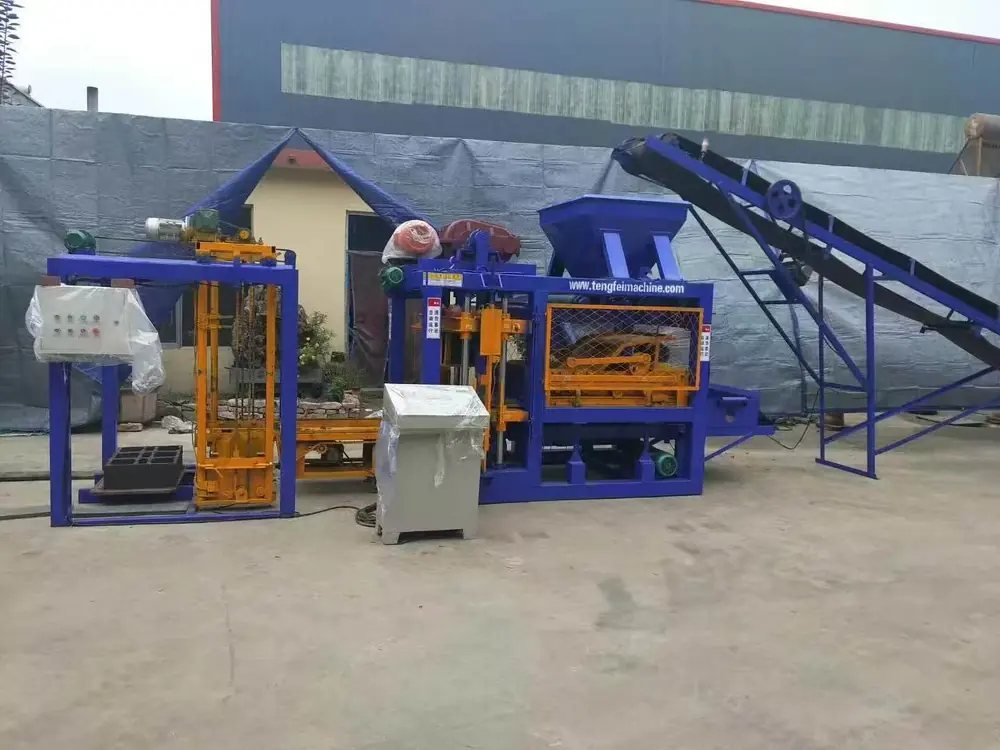
QT4-25 machines being assembled at Wojin’s factory workshop
A block machine is a heavy piece of equipment that runs all day, every day. The frame and structure need to be strong enough to handle constant vibration and pressure without bending or cracking.
Frame Material and Thickness
The frame of the QT4-25 should be made from Q235 steel (or better). The main columns should be at least 10mm thick. Anything thinner may bend over time.
How to check frame quality:
- Ask the supplier for the steel thickness specification
- Look at photos or videos of the machine from the side — the frame should look solid and heavy
- Check if there are reinforcing plates at stress points (where the vibration motors mount)
- Machine weight is a good clue — a 3,800 kg machine is probably better built than a 2,500 kg one
Mold Quality
The mold is one of the most important parts of the machine — it determines the shape, size, and surface quality of your blocks.
A good quality mold for the QT4-25 should last for 100,000 to 200,000 cycles before needing repair. Cheap molds may wear out after 30,000 to 50,000 cycles.
What to look for in a mold:
- Material: Manganese steel is best for long life
- Hardness: Should be HRC 55–60
- Surface finish: Smooth interior for clean block surfaces
- Welding quality: No cracks or rough welds
For more details on mold selection and care, read our guide: How to Choose the Right Mold for Your Block Machine.
Production Capacity and Output Analysis
One of the first questions people ask is: “How many blocks can it make per day?” Let us break down the real production numbers.
Theoretical vs. Actual Output
Manufacturers usually list “theoretical output” — the maximum number if everything runs perfectly. In real life, actual output is about 70–85% of the theoretical number.
| Block Type | Theoretical (8h) | Actual (8h) |
| Hollow block 400×200×200mm | 5,200 pcs | 4,500 – 4,800 pcs |
| Solid brick 240×115×53mm | 12,000 pcs | 10,000 – 11,000 pcs |
| Paving block 200×100×60mm | 8,000 pcs | 6,500 – 7,500 pcs |
| Curb stone 500×150×250mm | 1,200 pcs | 900 – 1,000 pcs |
Why is actual output lower?
- Material feeding takes time (especially on semi-automatic machines)
- Workers need short breaks
- Small adjustments and cleanings during the shift
- Sometimes you need to adjust mix ratio or vibration time
Monthly Production Estimate
If you run the machine 26 days per month, 8 hours per day:
- Hollow blocks: 4,500 × 26 = 117,000 blocks per month
- Solid bricks: 10,000 × 26 = 260,000 bricks per month
For a more detailed look at output calculations for different machine models, check our article: 8 Best QT Machines Rated by Output.
What Blocks Can the QT4-25 Produce?
One of the best things about the QT4-25 is its versatility. By changing the mold, you can produce many different types of blocks and bricks:
- Hollow concrete blocks — 4″, 6″, 8″, 9″ sizes
- Solid blocks — various dimensions
- Paving stones — interlocking, square, cobblestone
- Curb stones — road edging blocks
- Fly ash bricks — eco-friendly bricks using fly ash
- Interlocking bricks — mortarless wall blocks
Most suppliers include 1 or 2 molds with the machine. Additional molds cost between $300 and $1,500 depending on size and complexity.
Power Requirements and Energy Consumption
The QT4-25 uses about 11.6 kW of total installed power. This includes the hydraulic pump, vibration motors, and control panel.
Electricity Cost per Day
Actual power use is less than 11.6 kW because not all motors run at the same time. The machine uses about 6–8 kW on average during production.
For an 8-hour shift:
- Energy used: ~56 kWh per day
- At $0.10/kWh: $5.60 per day
- At $0.15/kWh: $8.40 per day
Compared to fully automatic machines (which use 25–50 kW), the QT4-25 is very energy efficient. This is a big advantage in areas where electricity is expensive or supply is limited.
Voltage Options
The standard voltage is 380V three-phase, 50Hz. Most manufacturers can customize for 220V, 415V, or 60Hz depending on your country. Always confirm the voltage before ordering.
Manpower Requirements
A semi-automatic machine needs more workers than a fully automatic one. Here is the typical crew for a QT4-25 line:
| Position | Number of Workers | Job Description |
| Machine Operator | 1 | Runs the control panel, adjusts settings |
| Mixer Operator | 1 | Operates the concrete mixer, feeds materials |
| Pallet Handlers | 2–3 | Loads/unloads pallets, moves finished blocks |
| Stacking Workers | 1–2 | Stacks cured blocks for delivery |
| Total | 4–6 workers |
Labor costs vary a lot by country. In many African countries, labor is relatively cheap, so a semi-automatic machine makes good economic sense. In places where labor is expensive, a fully automatic machine may be a better investment.
Pros and Cons of the QT4-25
✓ Advantages
- Affordable price — much cheaper than fully automatic machines
- Good output for small to medium factories
- Lower power consumption — saves on electricity costs
- Simple operation — workers learn quickly
- Easy maintenance — fewer moving parts than automatic machines
- Versatile — can make many block types by changing molds
- Compact size — fits in smaller factory spaces
- Good ROI — usually pays back within 12–18 months
✗ Disadvantages
- Lower output than fully automatic machines
- Needs more workers — higher labor cost
- Slower molding cycle (20–25 seconds vs. 15–20 for auto machines)
- Less consistent block quality (depends on operator skill)
- Manual material feeding is slower and less precise
- Lower hydraulic pressure — not ideal for high-strength blocks
- Harder to scale up production later
Is the QT4-25 Better Than the QT4-15?
This is a common question. The QT4-15 is the next step up — a fully automatic machine with better output but higher price. Here is a quick comparison:
| Feature | QT4-25 | QT4-15 |
| Automation | Semi-automatic | Fully automatic |
| Output (hollow/8h) | 4,500 – 5,200 | 5,760 – 9,600 |
| Hydraulic pressure | 5 – 8 MPa | 15 – 18 MPa |
| Total power | 11.6 kW | 27.5 kW |
| Workers needed | 4 – 6 | 2 – 3 |
| Price range | $5,000 – $8,000 | $10,000 – $15,000 |
For a detailed comparison, read our full article: QT4-15 vs QT6-15 vs QT8-15 Comparison.
Investment Cost and ROI Analysis
Total Investment Cost
The machine itself is only part of the total cost. Here is what you need to budget for:
| Item | Estimated Cost (USD) |
| QT4-25 Machine | $5,000 – $8,000 |
| Concrete Mixer (JS350 or similar) | $1,500 – $2,500 |
| Conveyor Belt | $500 – $1,000 |
| Pallets (200 pcs) | $800 – $1,500 |
| Extra Molds (1–2) | $500 – $2,000 |
| Shipping to Africa | $2,000 – $4,000 |
| Total Estimated | $10,300 – $19,000 |
Profit Estimate
Let us do a simple profit calculation for a factory making hollow blocks:
- Daily production: 4,500 hollow blocks
- Selling price per block: $0.20 (typical in many African markets)
- Daily revenue: 4,500 × $0.20 = $900
- Production cost per block: $0.08–$0.12 (cement, sand, labor, power)
- Daily profit: $360 – $540
- Monthly profit (26 days): $9,360 – $14,040
At this rate, the machine pays for itself in about 1–2 months of steady production. But remember — you need customers, raw material supply, and good management. The actual payback period is usually 6–12 months for a well-run business.
For a more detailed cost and profit analysis, see our article: How Much Does It Cost to Make a Concrete Block?
What to Check Before Buying
Not all QT4-25 machines are the same. Different manufacturers use different quality components. Here is a checklist:
- Hydraulic pump brand — Ask for the brand name. Good: Huade, Yuken. Unknown: risky.
- Steel frame thickness — Should be at least 8–10mm for main structure
- Vibration motor power — Should be 2 × 2.2 kW minimum
- Motor brands — Siemens, ABB, or reputable Chinese brands (Wannan, Yutong)
- Mold material — Manganese steel is better than regular steel
- Paint and finish — Good paint prevents rust and shows attention to quality
- Warranty — 1 year minimum for the whole machine, 2 years for main structure
- After-sales support — Do they send technicians for installation? Do they have spare parts?
Want a detailed quote for a QT4-25?
Contact Wojin Machinery for factory-direct pricing and free technical consultation.
Get a Free QuoteFrequently Asked Questions
The QT4-25 produces about 4,500 to 5,200 standard hollow blocks (400×200×200mm) per 8-hour shift. For solid bricks, output is around 10,000 to 12,000 pieces per day. Actual output depends on block size, material mix, and operator skill.
The QT4-25 semi-automatic block machine typically costs between $5,000 and $8,000 USD from a direct manufacturer like Wojin. Prices from trading companies are usually 30–50% higher. The final price depends on configuration, number of molds, and shipping costs.
Yes, the QT4-25 is an excellent choice for small to medium block factories. It offers a good balance of output and affordability. With a capacity of 4,500–5,200 blocks per shift, it can meet demand for most local construction projects. The semi-automatic operation means lower upfront cost compared to fully automatic machines.
A typical QT4-25 production line needs 4 to 6 workers:
- 1 machine operator
- 1 mixer operator / material feeder
- 2–3 workers for pallet handling and stacking
This is fewer workers than manual machines but more than fully automatic lines like the QT6-15.
Yes! By changing the mold, the QT4-25 can produce many block types:
- Hollow and solid blocks
- Paving stones and interlocking pavers
- Curb stones (road edging)
- Fly ash bricks
- Interlocking wall blocks
Most suppliers include 1–2 molds with the machine. Additional molds cost $300–$1,500 each.
Final Verdict
The QT4-25 semi-automatic block machine is a solid choice for anyone starting or expanding a block making business on a moderate budget. It offers good output, reasonable energy use, and a quick return on investment.
It is not the best machine for every situation. If you need high volume production or very consistent block quality, a fully automatic machine like the QT6-15 would be better. But if you are just starting out, or if you serve a local market with moderate demand, the QT4-25 is hard to beat for the price.
Our recommendation: Buy from a direct manufacturer like Wojin to get the best price and good after-sales support. Always ask for detailed specifications and photos of the actual machine before you pay.
Ready to learn more about the QT4-25?
Contact Wojin for a free technical consultation and detailed quotation.
Chat on WhatsApp