
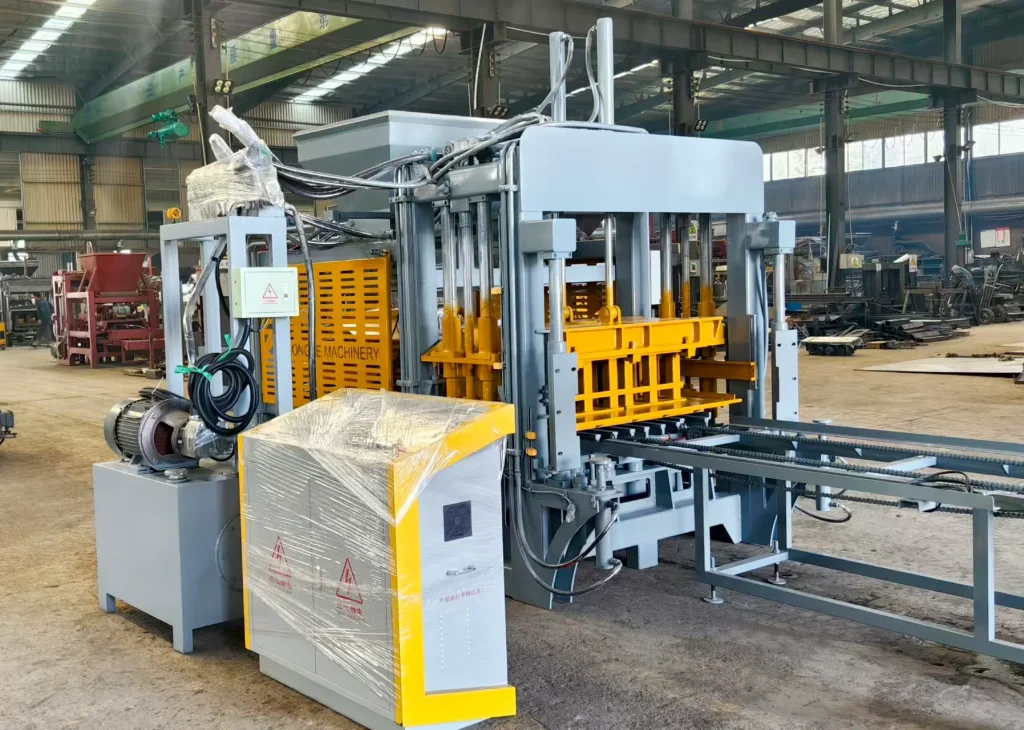
A fly ash brick making machine can turn industrial waste into high-quality, profitable building materials
Fly ash bricks are revolutionizing the construction industry across Africa and Southeast Asia. By turning a power plant waste product into durable, uniform building bricks, fly ash brick making machines offer one of the most profitable and environmentally friendly business opportunities available today.
Whether you’re a contractor looking to reduce material costs, an entrepreneur starting a brick-making business, or a government agency promoting sustainable construction, this complete setup guide will walk you through everything you need to know in 2026 — from raw materials and mix ratios to machine selection, production costs, and quality control.
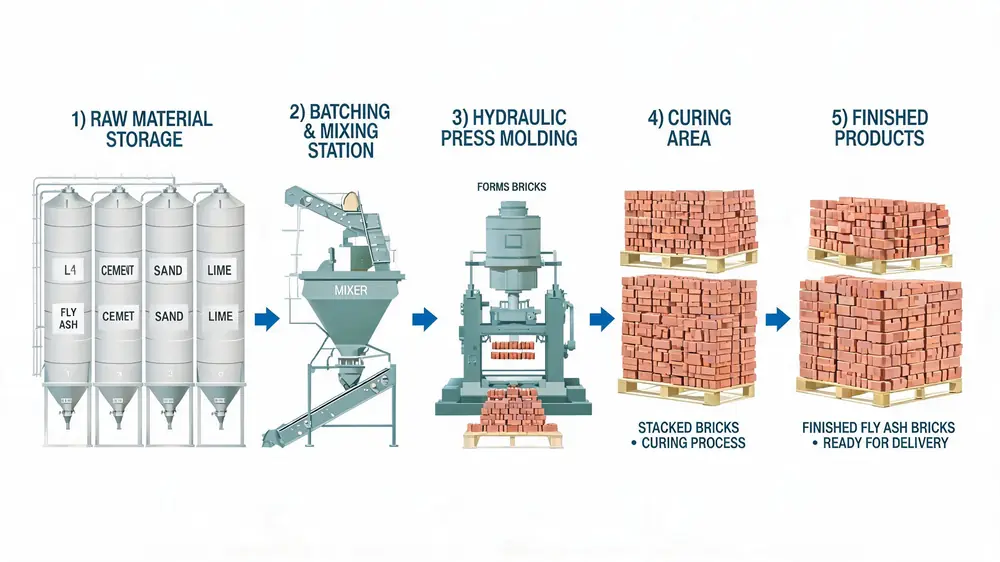
The fly ash brick production process — from raw materials to finished bricks in 5 stages
What Are Fly Ash Bricks?
Fly ash bricks are building blocks made from fly ash (a byproduct of coal-fired power plants), cement or lime, sand, and water. Unlike traditional clay bricks that require kiln firing at over 1,000°C, fly ash bricks are cured at ambient temperature or with steam — saving enormous amounts of energy and reducing CO₂ emissions by up to 80%.
The resulting bricks are uniform in size, smooth-surfaced, and typically have a compressive strength of 7.5 to 15 MPa — comparable to or better than traditional clay bricks. They’re ideal for wall construction, boundary walls, and partition walls.
Why fly ash bricks matter in 2026: With coal-fired power plants operating across South Africa, Nigeria, Zimbabwe, and India, millions of tons of fly ash are produced annually. Most of it goes to landfills. A fly ash brick making machine turns this waste into a valuable building material — solving an environmental problem while creating profit.
Advantages of Fly Ash Bricks Over Clay Bricks
Before diving into the setup process, let’s quickly cover why fly ash bricks are gaining market share across Africa and beyond:
| Property | Fly Ash Brick | Clay Brick |
|---|---|---|
| Compressive strength | 7.5 – 15 MPa | 10 – 30 MPa |
| Uniformity | High (machine-made) | Low (hand-molded) |
| Water absorption | 15 – 20% | 20 – 30% |
| Cement mortar saved | ~30% less | Baseline |
| Energy to produce | Low (no kiln) | High (kiln firing) |
| CO₂ emissions | ~80% lower | Baseline |
| Cost per brick | $0.15 – $0.30 | $0.30 – $0.80 |
Fly ash bricks are cheaper to produce, more uniform, more environmentally friendly, and require less mortar during construction. For a detailed comparison, see our guide on concrete block vs clay brick.
Raw Materials for Fly Ash Brick Production
One of the biggest advantages of fly ash brick manufacturing is that the raw materials are inexpensive and often locally available. Here’s what you need:
| Material | Proportion | Cost (per ton) | Source |
|---|---|---|---|
| Fly ash | 50 – 60% | Free – $15 | Power plants |
| Sand / Stone dust | 25 – 35% | $5 – $20 | Local quarries |
| Cement (OPC) | 8 – 12% | $80 – $120 | Cement suppliers |
| Lime (optional) | 5 – 10% | $40 – $80 | Lime suppliers |
| Gypsum (optional) | 2 – 3% | $30 – $60 | Chemical suppliers |
| Water | As needed | Minimal | Local supply |
Fly ash is the primary ingredient — and in many cases, power plants will give it away free or at very low cost because they need to dispose of it. This makes fly ash bricks incredibly cheap to produce.
Optimal Mix Ratios
Here are three proven mix ratios for different quality levels:
- Standard quality (7.5 MPa): 60% fly ash, 30% sand, 10% cement
- High quality (10 MPa): 55% fly ash, 30% sand, 12% cement, 3% gypsum
- Premium quality (15 MPa): 50% fly ash, 25% sand, 12% cement, 8% lime, 5% gypsum
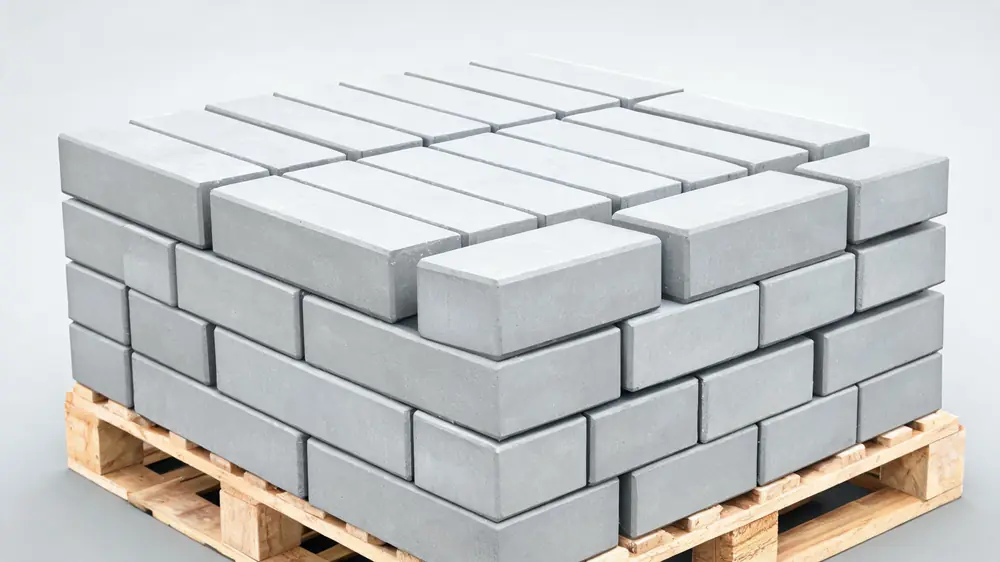
High-quality fly ash bricks — uniform size, smooth surface, and consistent color
How to Choose the Right Fly Ash Brick Machine
Not every block machine is suitable for fly ash brick production. Fly ash bricks require a machine that can handle fine powders and provide sufficient hydraulic pressure. Here are the key factors to consider:
1. Hydraulic Pressure
Fly ash bricks need hydraulic pressure of at least 16 MPa to achieve adequate density and strength. Machines like the QT4-15 and QT6-15 deliver 16-21 MPa — perfect for fly ash bricks.
2. Production Capacity
Choose a machine that matches your market demand. Here’s a quick guide:
| Machine Model | Output per 8h shift | Best For |
|---|---|---|
| QT4-35 (Manual) | 3,000 – 4,000 bricks | Small startups |
| QT4-15 (Auto) | 5,000 – 10,000 bricks | Medium businesses |
| QT6-15 (Auto) | 8,000 – 12,000 bricks | Growing factories |
| QT8-15 (Full Auto) | 14,000 – 20,000 bricks | Large-scale production |
3. Mold Compatibility
Fly ash bricks come in various sizes. Make sure your machine supports interchangeable molds. The most common fly ash brick sizes are 230×100×75mm (standard), 230×150×75mm, and 230×100×50mm. As we covered in our mold selection guide, a good machine should let you switch molds in under 30 minutes.
4. Automation Level
Fully automatic machines like the QT8-15 require less labor and produce more consistent quality. Semi-automatic models are more affordable but need 3-4 workers per shift.
Fly Ash Brick Production Process
Once your machine is set up, the production process follows these steps:
- Raw material preparation: Collect fly ash from a nearby power plant. Sieve sand and stone dust to remove oversized particles. Store all materials in covered bins to prevent moisture absorption.
- Batching: Weigh each material according to your mix ratio. For consistent quality, use an automatic batcher — manual weighing introduces variability that affects brick strength.
- Mixing: Use a forced-action pan mixer or double-shaft mixer. Dry mix for 2 minutes, then add water and mix for another 3-4 minutes. The mix should hold together when squeezed in your hand but not drip water.
- Molding: Feed the mix into the block machine’s hopper. The machine fills the mold, applies hydraulic pressure (16+ MPa), and vibrates simultaneously for 15-30 seconds to remove air pockets and compact the brick.
- Demolding: The hydraulic press releases, and the formed brick is pushed onto a pallet. The pallet is transported to the curing area by conveyor or manually.
- Curing: Fly ash bricks cure differently than concrete blocks. See the curing section below for details.
- Quality check & storage: After curing, test random samples for compressive strength. Stack certified bricks in the storage yard, ready for delivery.
Curing Methods for Fly Ash Bricks
Curing is critical for fly ash brick quality. Unlike concrete blocks that cure in 7-28 days, fly ash bricks have different curing requirements depending on the binder used:
Method 1: Water Curing (Cement-Based Bricks)
If your mix uses cement as the primary binder, cure the bricks by sprinkling water 2-3 times daily for 7-14 days. Keep bricks covered with plastic sheeting to retain moisture. Compressive strength reaches 70% in 7 days and 100% in 28 days.
Method 2: Steam Curing (Lime-Based Bricks)
If your mix uses lime instead of cement, use steam curing. Stack bricks in a steam chamber at 60-80°C for 6-8 hours. This accelerates the pozzolanic reaction between fly ash and lime. Steam-cured bricks reach full strength in 24 hours — making this the fastest production cycle available.
Method 3: Ambient Curing (Warm Climate)
In hot African climates (25-35°C year-round), fly ash bricks can cure in the open air. Simply stack bricks on pallets and let them sit for 14-21 days. While slower than steam curing, this method requires no special equipment and is completely free.
Pro tip: For maximum early strength, combine methods — steam cure for 8 hours, then water cure for 7 days. This produces bricks with 15+ MPa compressive strength in under 10 days.
Setup Cost Breakdown
Here’s what you can expect to invest in a fly ash brick making operation:
| Item | Budget Setup (Manual) | Standard Setup (Semi-Auto) | Industrial Setup (Full Auto) |
|---|---|---|---|
| Block machine | $3,000 – $5,000 | $12,000 – $20,000 | $28,000 – $50,000 |
| Pan mixer | $800 – $1,500 | $2,000 – $4,000 | $5,000 – $8,000 |
| Conveyor system | Manual | $1,500 – $3,000 | $5,000 – $10,000 |
| Pallets (200 pcs) | $400 | $800 | $1,500 |
| Steam chamber | Optional | $1,000 – $2,500 | $5,000 – $10,000 |
| Molds (3 types) | $500 | $1,200 | $2,500 |
| Site preparation | $500 | $2,000 | $5,000 |
| Total investment | $5,200 – $8,200 | $19,500 – $33,300 | $52,000 – $87,000 |
| Working capital (2 months) | $1,500 | $4,000 | $10,000 |
At these investment levels, a fly ash brick business can break even in 6-12 months, depending on local demand and selling price. For more on the business side, see our block machine business startup guide.
Not sure which machine is right for your fly ash brick business?
Wojin Machinery offers free consultation to help you select the right machine, molds, and setup for your budget and market. Get a customized quote within 24 hours.
Get a Free QuoteQuality Control: Ensuring Consistent Brick Quality
Quality control is what separates profitable fly ash brick businesses from failing ones. Here are the key tests you should perform regularly:
Daily Checks
- Mix moisture: Squeeze a handful of mix — it should form a ball that breaks apart when poked. Too wet = deformed bricks; too dry = weak bricks.
- Brick dimensions: Measure 5 random bricks per shift. Variation should be within ±2mm.
- Surface finish: Bricks should have smooth, even surfaces with no cracks or voids.
Weekly Tests
- Compressive strength: Test 3 bricks from each week’s production. Standard fly ash bricks should achieve 7.5+ MPa after 7 days.
- Water absorption: Weigh a dry brick, soak it in water for 24 hours, weigh again. Absorption should be below 20%.
- Efflorescence test: Place a brick in water for 24 hours, then dry in sun. No white salt deposits should appear on the surface.
Keep a logbook of all test results. If quality drops, the first thing to check is your machine maintenance — worn molds and low hydraulic pressure are the most common causes of quality issues.
Market Potential for Fly Ash Bricks in 2026
The fly ash brick market is growing rapidly across developing economies. Here’s why demand is increasing:
- Government incentives: Many countries now mandate fly ash utilization in construction within 100km of power plants
- Cost advantage: Fly ash bricks cost 40-60% less than clay bricks
- Environmental regulations: Clay brick kilns face increasing restrictions due to deforestation and emissions
- Quality consistency: Machine-made fly ash bricks are far more uniform than hand-molded clay bricks
- Growing construction: Africa’s construction market grows 6-8% annually, driving demand for affordable building materials
With a fly ash brick making machine, you can produce bricks for $0.15-$0.30 each and sell them for $0.50-$0.80 — a gross margin of 60-70%. For a factory producing 10,000 bricks per day, that’s $2,000-$5,000 in daily revenue.
Frequently Asked Questions
What is the difference between fly ash bricks and concrete blocks?
Fly ash bricks use fly ash as the primary material (50-60%) with cement or lime as a binder. Concrete blocks use cement, sand, and aggregate. Fly ash bricks are smaller (brick-sized), smoother, and ideal for wall construction. Concrete blocks are larger, can be hollow, and are used for load-bearing walls. Both can be produced on the same machine by changing molds.
How much does a fly ash brick making machine cost?
A manual fly ash brick machine starts at around $3,000. Semi-automatic models cost $12,000-$20,000. Fully automatic production lines range from $28,000-$50,000. The total setup cost including mixer, pallets, molds, and site preparation ranges from $5,000 for a basic setup to $87,000 for an industrial production line.
Where can I get fly ash for brick production?
Fly ash is available from any coal-fired power plant. In Africa, major sources include South Africa (Eskom power stations), Zimbabwe (Hwange Power Station), and Nigeria. In many cases, power plants provide fly ash free or at nominal cost because they need to dispose of it. Transport is typically the main cost — so locate your factory within 50-100km of a power plant for best economics.
How long does it take for fly ash bricks to cure?
Cement-based fly ash bricks need 7-14 days of water curing. Lime-based bricks can be steam-cured in 24 hours. In warm African climates (25-35°C), ambient curing takes 14-21 days. For fastest results, use steam curing followed by 7 days of water curing to achieve 15+ MPa compressive strength.
Can I produce both fly ash bricks and concrete blocks on the same machine?
Yes. All Wojin block machines support interchangeable molds. You can produce fly ash bricks, hollow concrete blocks, solid blocks, and pavers on the same machine — just by changing the mold. This flexibility lets you serve multiple markets and maximize your return on investment. See our mold selection guide for details.
Conclusion
Setting up a fly ash brick making machine is one of the smartest investments you can make in 2026. With low raw material costs (fly ash is nearly free), growing environmental regulations against clay brick kilns, and strong demand for affordable building materials across Africa and Asia, the market opportunity is significant.
Here’s a quick summary to get started:
- Choose your machine based on target output — QT4-15 for medium, QT6-15 or QT8-15 for high volume
- Secure fly ash supply from a nearby power plant
- Test your mix ratio — start with 60% fly ash, 30% sand, 10% cement
- Choose a curing method — steam curing is fastest, water curing is simplest
- Implement quality control — test compressive strength weekly
- Plan for growth — start with one machine and expand as demand grows
At Wojin Machinery, we’ve helped entrepreneurs across 60+ countries set up fly ash brick production lines. Our machines come with free molds, installation guidance, and lifetime technical support. Proper maintenance ensures your machine runs at peak performance for years.
Start Your Fly Ash Brick Business