
Concrete blocks offer cost savings and faster construction — but how do they really compare to clay bricks?
If you’re planning a construction project in Africa — whether it’s a family home in Lagos, a commercial building in Nairobi, or a housing estate in Accra — one of the first decisions you’ll face is the building material. The two most common options are concrete blocks and clay bricks. Both have been used for centuries, but which one is actually better for your project?
This is a question we hear every day from customers buying block making machines across Africa. The answer isn’t as simple as “concrete is always better” or “clay is always better.” It depends on your budget, location, climate, project type, and long-term goals.
In this article, we’ll compare concrete blocks and clay bricks across seven key factors — cost, strength, thermal insulation, construction speed, durability, environmental impact, and availability — so you can make an informed decision for your next project.
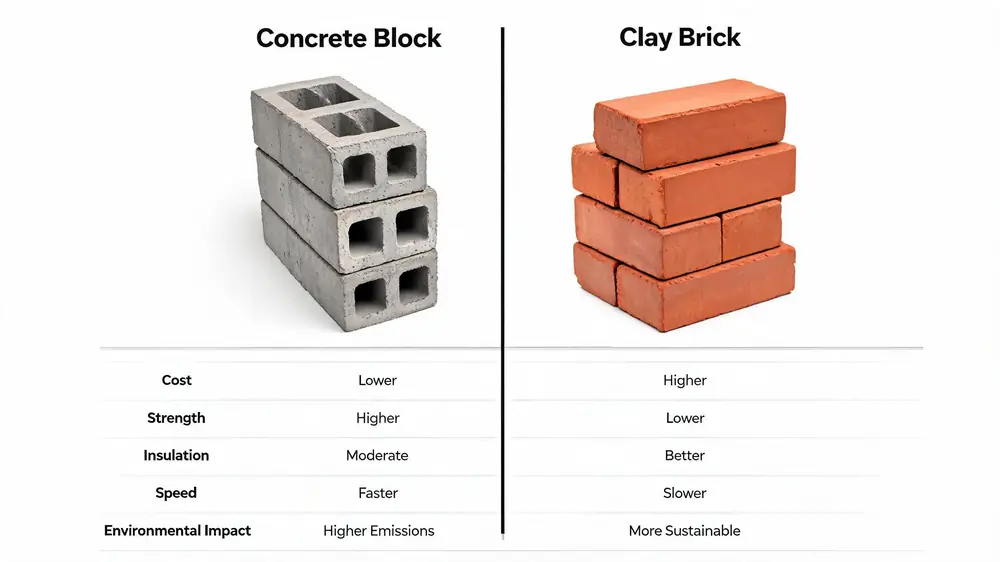
Concrete block vs clay brick — a side-by-side comparison across key factors
1. Cost Comparison: Concrete Block vs Clay Brick
Cost is usually the deciding factor for most builders in Africa. Here’s the breakdown:
| Cost Factor | Concrete Block | Clay Brick |
|---|---|---|
| Material cost per m² of wall | $8 – $15 | $15 – $30 |
| Production cost (if self-produced) | $0.30 – $0.50/block | N/A (requires kiln) |
| Mortar usage | Less (larger blocks) | More (smaller units) |
| Transport cost | Lower (locally produced) | Higher (often imported) |
| Labor cost per m² | Lower (faster laying) | Higher (slower laying) |
Concrete blocks win on cost — especially if you produce them yourself with a block making machine. A hollow concrete block costs roughly $0.30 to $0.50 to produce, while a clay brick of equivalent wall area costs $0.80 to $1.50. Over a full project, this difference can amount to thousands of dollars in savings.
Key takeaway: For a standard 3-bedroom house (approximately 150m² of wall area), concrete blocks can save you 40-60% on material costs compared to clay bricks.
2. Compressive Strength: Which Is Stronger?
Strength matters — especially for load-bearing walls and multi-story buildings. Both materials can be engineered to meet structural requirements, but they differ in typical strength ranges:
| Property | Concrete Block | Clay Brick |
|---|---|---|
| Typical compressive strength | 5 – 15 MPa | 10 – 30 MPa |
| Hollow block strength | 3 – 7 MPa | N/A |
| Solid block strength | 10 – 25 MPa | 15 – 35 MPa |
| Reinforcement compatibility | Excellent (can add rebar) | Poor (difficult to reinforce) |
| Fire resistance | 2 – 4 hours | 1 – 2 hours |
Clay bricks typically have higher raw compressive strength per unit. However, concrete blocks — especially solid blocks — can be reinforced with steel rebar, making concrete block walls stronger in earthquake-prone areas. In regions like Kenya’s Rift Valley or Ghana’s coastal zones, reinforced concrete block construction is the preferred choice for structural safety.
With a QT6-15 hydraulic block machine, you can produce blocks with compressive strengths of 15+ MPa by optimizing the cement ratio and using proper vibration. This meets most building code requirements across African countries.
3. Thermal and Sound Insulation
In Africa’s hot climate, thermal performance is crucial for comfortable living. Here’s how the two materials compare:
Thermal Insulation
- Hollow concrete blocks trap air in their voids, providing natural insulation. A 200mm hollow block wall has a thermal resistance (R-value) of approximately 0.35-0.45.
- Clay bricks have slightly better thermal mass — they absorb heat during the day and release it at night. A solid clay brick wall has an R-value of about 0.40-0.50.
- Winner: Clay brick has a slight edge in thermal mass, but hollow concrete blocks are very close and far cheaper.
Sound Insulation
- Concrete blocks — especially solid blocks — provide excellent sound insulation, with sound transmission class (STC) ratings of 45-55 for a 200mm wall.
- Clay bricks also perform well, with STC ratings of 50-60 for a similar wall thickness.
- Winner: Clay brick, but only marginally. For most residential applications, the difference is negligible.
4. Construction Speed: Time Is Money
This is where concrete blocks have a massive advantage. A standard hollow concrete block measures 400×200×200mm — equivalent to about 6 standard clay bricks in wall area. This means:
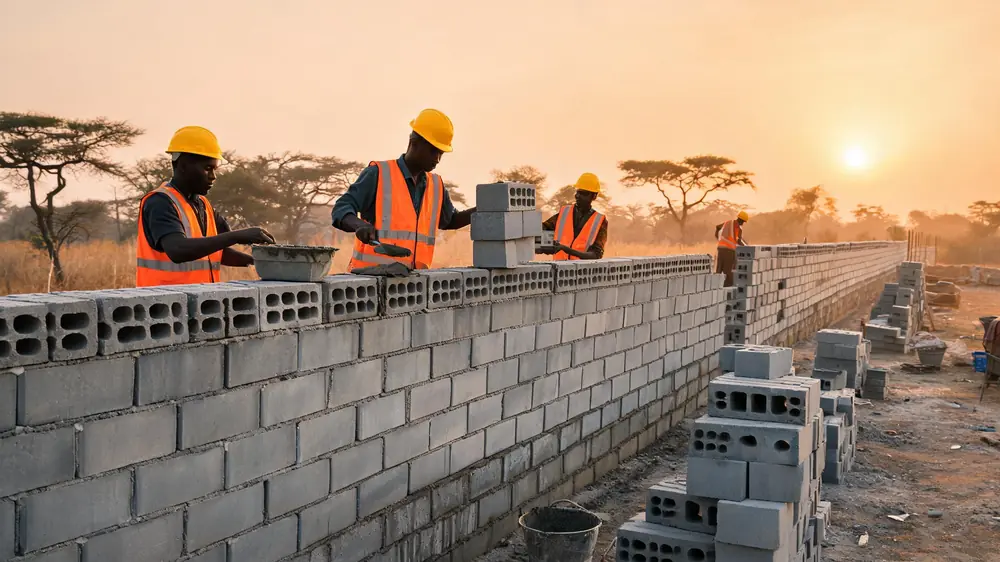
Building with concrete blocks is significantly faster than laying individual clay bricks
| Speed Factor | Concrete Block | Clay Brick |
|---|---|---|
| Blocks/bricks per m² of wall | 12.5 blocks | ~75 bricks |
| Wall area per worker per day | 40-50 m² | 15-20 m² |
| Mortar joints per m² | ~13 joints | ~75 joints |
| Time to complete 100 m² wall | 2-3 days | 5-7 days |
A mason can lay concrete blocks 2.5 to 3 times faster than clay bricks. For a typical house, this means cutting construction time by 40-50%. In markets where labor costs are rising — like South Africa and Kenya — this speed advantage translates directly into cost savings.
5. Durability and Weather Resistance
Africa’s climate poses unique challenges: heavy rainfall in West Africa, extreme heat in the Sahel, and humidity in coastal regions. How do the two materials hold up?
Concrete Blocks
- Rain resistance: Good — but hollow blocks can absorb water if not properly sealed. Waterproofing additives can be mixed into the concrete.
- UV resistance: Excellent — concrete doesn’t degrade under sunlight.
- Lifespan: 50-100+ years with proper construction.
- Cracking: Can crack if soil settles unevenly, but reinforced block walls resist cracking well.
Clay Bricks
- Rain resistance: Good — fired clay is naturally water-resistant but can spall if moisture freezes (rare in most of Africa).
- UV resistance: Excellent — color doesn’t fade.
- Lifespan: 100+ years. Some clay brick buildings from the colonial era are still standing.
- Cracking: Brittle — cracks more easily under ground movement.
Both materials are durable, but clay brick has a longer track record — some clay brick structures have lasted centuries. However, properly made concrete blocks can easily last 50-100 years, which is more than sufficient for most projects.
6. Environmental Impact
Sustainability is becoming increasingly important in African construction. Here’s how the two materials compare environmentally:
| Environmental Factor | Concrete Block | Clay Brick |
|---|---|---|
| Energy to produce | Low (cement + vibration) | High (kiln firing at 1000°C+) |
| CO₂ emissions per m² | ~30 kg | ~50 kg |
| Use of recycled materials | Yes (fly ash, slag) | Limited |
| Local availability | High (cement + sand everywhere) | Medium (requires clay deposits) |
| End-of-life recyclability | Can be crushed as aggregate | Can be crushed as aggregate |
Concrete blocks — especially those made with fly ash or slag replacing cement — have a lower carbon footprint than clay bricks. Clay brick production requires firing kilns at temperatures above 1,000°C, which consumes significant energy (often firewood in rural Africa, contributing to deforestation).
If you’re producing blocks with a block making machine, you can use locally sourced materials and even incorporate industrial waste like fly ash, making concrete blocks the more sustainable choice.
7. Availability and Local Production
In most African countries, concrete blocks are easier to source than clay bricks. Here’s why:
- Cement is available in every African city and town — brands like Dangote, Bamburi, Lafarge, and PPC have widespread distribution networks.
- Sand and aggregate are locally available almost everywhere.
- Block making machines can be set up on-site, eliminating transport costs entirely. A mobile block machine can produce blocks directly at the construction site.
- Clay deposits are not available everywhere — coastal regions and sandy areas may have no local clay source.
- Kiln infrastructure for clay brick firing requires significant setup and is limited to established brick-making areas.
For remote project sites, the ability to produce blocks on-site is a game-changer. A block making business can be started with minimal infrastructure — just a machine, cement, sand, and water.
Summary: Concrete Block vs Clay Brick at a Glance
| Factor | Concrete Block | Clay Brick | Winner |
|---|---|---|---|
| Cost | $8-15/m² | $15-30/m² | Concrete |
| Strength (solid) | 10-25 MPa | 15-35 MPa | Clay |
| Reinforcement | Excellent | Poor | Concrete |
| Thermal insulation | Good (hollow) | Slightly better | Clay (marginal) |
| Construction speed | 2-3x faster | Slower | Concrete |
| Durability | 50-100 years | 100+ years | Clay |
| Environmental impact | Lower CO₂ | Higher CO₂ | Concrete |
| Local availability | Everywhere | Limited to clay areas | Concrete |
| Fire resistance | 2-4 hours | 1-2 hours | Concrete |
Score: Concrete Block 6, Clay Brick 3. For most construction projects in Africa, concrete blocks offer better value — lower cost, faster construction, easier availability, and lower environmental impact.
Want to produce your own concrete blocks?
Wojin Machinery offers block making machines for every budget — from manual models starting at $1,000 to fully automatic production lines. Get a free quote today and start saving on building materials.
Get a Free QuoteFrequently Asked Questions
Are concrete blocks cheaper than clay bricks in Africa?
Yes. Concrete blocks cost approximately 40-60% less per square meter of wall than clay bricks. If you produce your own blocks with a block making machine, the savings are even greater — production cost can be as low as $0.30 per block. Clay bricks require kiln firing, which is energy-intensive and expensive, especially when firewood is used as fuel.
Which lasts longer, concrete blocks or clay bricks?
Clay bricks have a longer lifespan — some clay brick structures have lasted centuries. However, properly made concrete blocks can last 50-100+ years, which is more than sufficient for most buildings. The key to longevity is proper mix design, adequate curing, and good construction practices. With a quality block making machine, you can produce blocks that last as long as the building itself.
Can I use concrete blocks for load-bearing walls?
Yes. Solid concrete blocks with compressive strength of 10 MPa or higher are suitable for load-bearing walls up to 3-4 stories. For taller structures, reinforced hollow blocks (with rebar placed in the voids and filled with concrete) can be used. Always consult a structural engineer and check local building codes for specific requirements.
How many blocks can a block making machine produce per day?
Production capacity varies by machine model. A manual machine like the QMJ2-40 produces about 1,280 blocks per 8-hour shift. A semi-automatic like the QT4-25 produces 4,500-5,248 blocks per shift. A fully automatic like the QT8-15 can produce over 120,000 blocks per shift. Check our maintenance guide to keep your machine running at full capacity.
Conclusion
For most construction projects in Africa, concrete blocks are the better choice. They cost less, build faster, are easier to source locally, and have a lower environmental impact. While clay bricks win on raw compressive strength and longevity, these advantages rarely justify the 2-3x higher cost for typical residential and commercial construction.
If you’re a contractor, developer, or entrepreneur looking to reduce building costs, the smartest move is to invest in your own block making machine. Producing blocks on-site eliminates material transport costs, ensures consistent quality, and gives you full control over your supply chain.
- Choose concrete blocks if you want lower cost, faster construction, and local availability
- Choose clay bricks if you need maximum unit strength, aesthetic appeal, and centuries-long lifespan
- Choose both — clay brick veneer over concrete block walls — for the best of both worlds on premium projects
At Wojin Machinery, we’ve helped thousands of African builders switch from buying clay bricks to producing their own concrete blocks. Contact us today to find the right machine for your project.
Get a Free Consultation