
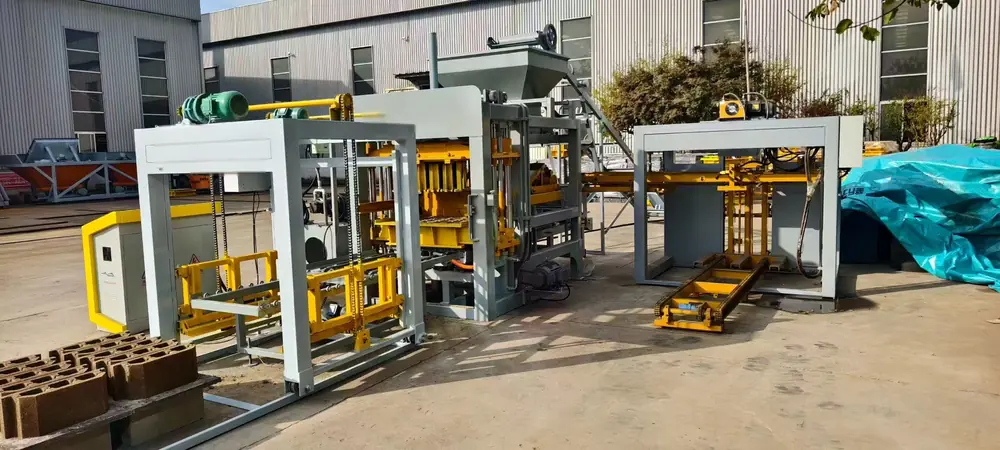
The QT5-15 and QT6-15 are two of the most popular mid-range fully automatic block making machines on the market. Both use hydraulic vibration technology. Both produce high-quality concrete blocks. And both sit in that sweet spot between entry-level semi-automatic machines and heavy-duty production lines.
But which one is right for your business? The difference of one mold position may seem small, but it affects production output, power requirements, price, and profitability. In this guide, we compare the two machines side by side to help you make the right choice.
- The QT6-15 produces 20% more blocks per day than the QT5-15 (10,000 vs 8,000 hollow blocks)
- Price difference is about $5,000–$8,000 for a complete production line
- QT6-15 needs 45–55 kW power; QT5-15 needs 35–45 kW
- Both use the same hydraulic vibration technology and PLC control system
- QT5-15 is better for small factories; QT6-15 pays off faster at higher capacity
What Are the QT5-15 and QT6-15?
QT5-15: The Compact Mid-Range Machine
The QT5-15 block making machine produces 5 hollow blocks per mold cycle. It is the smaller of the two mid-range fully automatic models. With a daily output of about 8,000 hollow blocks, it is ideal for small to medium block factories looking to upgrade from manual or semi-automatic production.
The QT5-15 uses the same hydraulic vibration system as larger models, just on a smaller frame. It can produce hollow blocks, solid bricks, paving stones, and curb stones with the right molds.
QT6-15: The Best-Selling Mid-Range Machine
The QT6-15 block making machine is one of the best-selling models in the entire QT series. It produces 6 hollow blocks per mold cycle, for a daily output of about 10,000 blocks per shift.
Many buyers choose the QT6-15 because it strikes the perfect balance between capacity and cost. It offers most of the performance of larger machines like the QT8-15, but at a much lower price point. It is the go-to choice for medium-sized block factories with steady market demand.
QT5-15 vs QT6-15: Side-by-Side Comparison Table
Full Technical Spec Comparison
The table below compares the key technical specifications of both machines side by side:
| Specification | QT5-15 | QT6-15 |
|---|---|---|
| Hollow blocks per mold | 5 pieces | 6 pieces |
| Cycle time | 15–20 seconds | 15–20 seconds |
| Daily output (hollow blocks, 8h) | 7,000–8,500 | 9,000–11,000 |
| Molding board size | 850 × 650 mm | 1050 × 650 mm |
| Vibration motor power | 2 × 5.5 kW | 4 × 5.5 kW |
| Hydraulic pressure | 16–20 MPa | 18–22 MPa |
| Total power consumption | 35–45 kW | 45–55 kW |
| Main machine weight | ~6,500 kg | ~8,500 kg |
| Machine price (main unit) | $22K – $35K | $28K – $42K |
| Workers required | 3–4 people | 3–4 people |
| Control system | PLC + touch screen | PLC + touch screen |
The QT6-15 wins on performance — more output, stronger vibration, heavier frame, and the same labor requirement. The QT5-15 wins on cost — lower price, lower power needs, and smaller footprint.
QT5-15 vs QT6-15 Production Capacity
Daily Output by Product Type
The 20% difference in mold positions translates directly to more blocks per day. Here is how they compare for common products:
| Product Type | QT5-15 (per shift) | QT6-15 (per shift) |
|---|---|---|
| Hollow blocks (400×200×200mm) | 7,000 – 8,500 | 9,000 – 11,000 |
| Solid bricks (240×115×53mm) | 20,000 – 25,000 | 26,000 – 32,000 |
| Paving blocks (200×100×60mm) | 12,000 – 15,000 | 16,000 – 20,000 |
| Curb stones (500×150×250mm) | 800 – 1,000 | 1,000 – 1,200 |
Revenue Difference Per Month
Let us use hollow blocks as an example to see the revenue gap:
- QT5-15: 8,000 blocks/day × 26 days = 208,000 blocks/month
- QT6-15: 10,000 blocks/day × 26 days = 260,000 blocks/month
At $0.20 per block, the QT6-15 generates $10,400 more revenue per month. Over a year, that is $124,800 in extra sales — far more than the $5K–$8K price difference between the two machines.
QT5-15 vs QT6-15 Cost Comparison
Machine Price Difference
The QT6-15 costs more upfront, but not by as much as you might think:
- QT5-15 main machine: $22,000 – $35,000
- QT6-15 main machine: $28,000 – $42,000
- Price gap: about $6,000 – $7,000
Prices vary by manufacturer, configuration, and included accessories. Always compare complete lines, not just the main machine.
Complete Production Line Cost
A full production line includes mixer, batching machine, conveyor, stacker, molds, and control panel.
- QT5-15 full line: $38,000 – $55,000
- QT6-15 full line: $45,000 – $65,000
- Price gap: about $7,000 – $10,000
For a more detailed breakdown of what goes into a complete line, read our guide on block machine investment costs.
Operating Cost Difference
The QT6-15 uses more electricity, but the per-block cost is actually lower because output is higher:
- Electricity: QT6-15 uses 20–25% more power total, but cost per block is similar
- Labor: Same number of workers (3–4 people) — big advantage for the QT6-15
- Raw materials: Same cost per block (same mix design)
- Maintenance: Slightly higher for QT6-15 due to more vibration motors
QT5-15 vs QT6-15 Build Quality
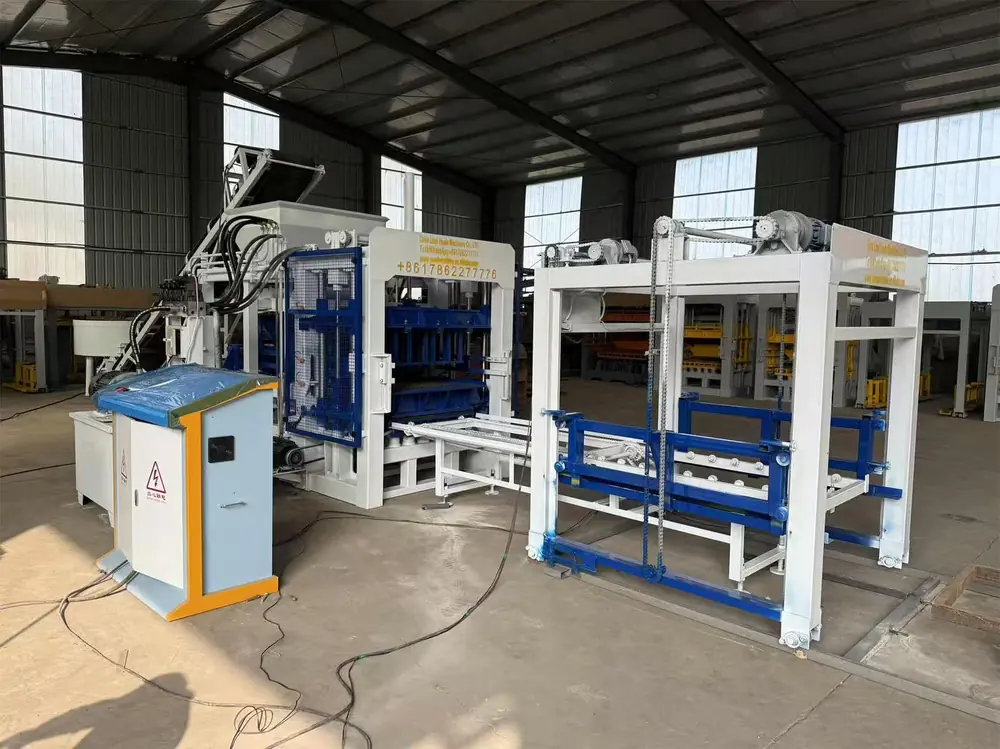
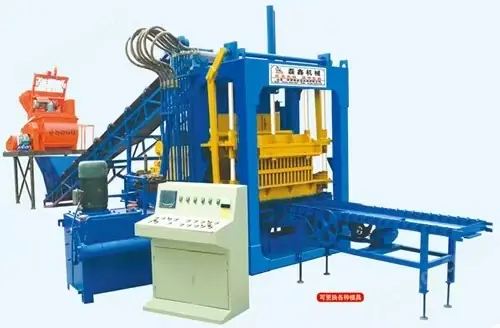
Left: QT6-15 with 4 vibration motors; Right: QT5-15 compact frame design
Vibration System
The vibration system determines block density and strength. This is where the biggest quality difference lies.
- QT5-15: 2 vibration motors (2 × 5.5 kW = 11 kW total)
- QT6-15: 4 vibration motors (4 × 5.5 kW = 22 kW total)
The QT6-15 produces stronger, more even vibration across the entire mold table. This means denser blocks with higher compressive strength. For products like paving stones and curb stones that need extra strength, the QT6-15 delivers better results.
Frame and Structure
A heavier, stiffer frame means less vibration loss and longer machine life.
- QT5-15: ~6,500 kg, standard frame thickness
- QT6-15: ~8,500 kg, reinforced frame with thicker steel
The heavier QT6-15 frame absorbs vibration better. It will likely last 2–3 years longer than the QT5-15 with the same level of maintenance.
Product Range and Versatility
Both machines can make the same types of products, but the QT6-15 handles larger and denser products better:
- Both can make: hollow blocks, solid bricks, perforated bricks, standard paving blocks
- QT6-15 is better for: thick paving stones, heavy curb stones, large retaining wall blocks
- QT5-15 is better for: standard hollow blocks and smaller products
QT5-15 vs QT6-15: Pros and Cons
QT5-15 Advantages and Disadvantages
✅ Pros
- Lower purchase price
- Lower power requirements
- Smaller factory footprint
- Faster installation and setup
- Easier to maintain (fewer parts)
- Lower shipping cost (lighter)
❌ Cons
- 20% lower production output
- Weaker vibration (2 motors vs 4)
- Not ideal for heavy products
- Slower ROI at high capacity
- Limited room for growth
QT6-15 Advantages and Disadvantages
✅ Pros
- 20% higher daily output
- Stronger vibration (4 motors)
- Denser, stronger blocks
- Better for heavy products
- Same labor as QT5-15
- More room for business growth
- Faster payback at full capacity
❌ Cons
- Higher upfront cost
- Higher power consumption
- Larger space required
- Higher shipping cost
QT5-15 vs QT6-15: Which Should You Buy?
Choose the QT5-15 If…
The QT5-15 is the better choice in these situations:
- You have a small factory with limited space
- Your electricity supply is limited (under 50 kW)
- Your budget is tight — every dollar counts
- You expect to produce 5,000–7,000 blocks per day
- You mainly make standard hollow blocks and solid bricks
- You are upgrading from a QT4-25 semi-automatic and want to go slow
Choose the QT6-15 If…
The QT6-15 is the better choice in these situations:
- You have steady demand for 8,000+ blocks per day
- You want room to grow without buying another machine
- You make heavy products like curb stones or thick pavers
- You have reliable 3-phase power (55 kW+)
- You can afford the slightly higher investment
- You plan to run two shifts in the future
If you can afford the extra $6,000–$10,000, choose the QT6-15. The 20% extra output, stronger vibration, and longer lifespan make it the better long-term investment. Most buyers regret buying too small far more often than they regret buying too big.
Only choose the QT5-15 if you have hard limits on budget, electricity, or factory space.
QT5-15 vs QT6-15 FAQs
The main difference is production capacity. The QT6-15 makes 6 hollow blocks per mold cycle, while the QT5-15 makes 5. That is a 20% output difference.
Other key differences:
- QT6-15 has 4 vibration motors vs. 2 on the QT5-15
- QT6-15 has a heavier frame (8,500 kg vs. 6,500 kg)
- QT6-15 uses more power (45–55 kW vs. 35–45 kW)
The QT6-15 costs about $6,000 to $10,000 more for a complete production line.
For reference:
- QT5-15 full line: $38K – $55K
- QT6-15 full line: $45K – $65K
The extra cost pays for itself quickly if you use the additional capacity. At full production, the QT6-15 generates about $10K more revenue per month.
Yes, the QT5-15 can make paving blocks and curb stones with the right molds. However, block quality may not be as high as the QT6-15 for heavier products.
The QT6-15’s 4 vibration motors produce denser blocks. If you mainly make thick paving stones or heavy curb stones, the QT6-15 gives better results.
Both machines need the same number of workers: 3 to 4 people per shift.
Typical team:
- 1 machine operator (PLC control panel)
- 1 worker (mixer and raw materials)
- 1–2 workers (quality check and block stacking)
This is why the QT6-15 is often better value — same labor cost, 20% more output.
Yes, for most buyers, the QT6-15 is worth the extra investment.
Three reasons:
- 20% more output for only 15–20% more cost
- Same labor requirement — lower per-block labor cost
- Room to grow — you will not outgrow it as quickly
The QT5-15 is only better if you have hard limits on budget, electricity, or space.
At full capacity with good market prices, both machines typically pay back in 8 to 14 months.
Estimated monthly net profit:
- QT5-15: $4,000 – $7,000 per month
- QT6-15: $5,500 – $9,000 per month
Actual ROI depends on your local market prices, raw material costs, and how consistently you run the machine.
Final Thoughts
The Bottom Line
Both the QT5-15 and QT6-15 are excellent mid-range fully automatic block machines. They use the same proven technology, the same control system, and require the same number of workers. The difference comes down to capacity and cost.
The QT5-15 is a solid choice for small factories or buyers on a tight budget. The QT6-15 offers better value for money if you can use the extra output.
Still Not Sure Which One to Buy?
If you are still deciding between these two machines, ask yourself these questions:
- How many blocks can I realistically sell per day?
- Do I have enough 3-phase power for the larger machine?
- Will I need to make heavy products like curb stones later?
- Can I afford the extra cost without cash flow problems?
If you answer “yes” to most of these, go with the QT6-15. If not, the QT5-15 will serve you well.
Get a Free Consultation
Want a personalized recommendation based on your specific situation? The Wojin technical team can help you choose the right machine for your market, budget, and production goals.
We will ask about your local market, available space, power supply, and budget. Then we will recommend the best machine and configuration for your needs. No obligation, just honest advice.
Disclaimer & Disclosure
Editorial Disclosure: This article is published by Wojin Machinery, a manufacturer of concrete block making machines. We have a financial interest in the products discussed. However, the specifications, performance data, and price ranges in this guide reflect our real customer data and 2026 factory direct pricing, not theoretical marketing claims.
Data Sources: Production capacity figures come from real-world factory output measurements of our installed machines across multiple countries. Price data reflects our 2026 ex-factory pricing for standard configurations. ROI examples are for illustrative purposes only — actual results vary by location, market conditions, and management quality.
Financial Disclaimer: This article provides general information only and is not financial advice. Investment returns depend on many factors beyond equipment quality, including local market prices, labor costs, electricity reliability, and management skill. Always conduct your own market research and consult a business advisor before making investment decisions.
Need help choosing between the QT5-15 and QT6-15?
Get a free consultation and customized quotation from our technical team.
Get Free Consultation